
Your Pricing Model Is a Confession
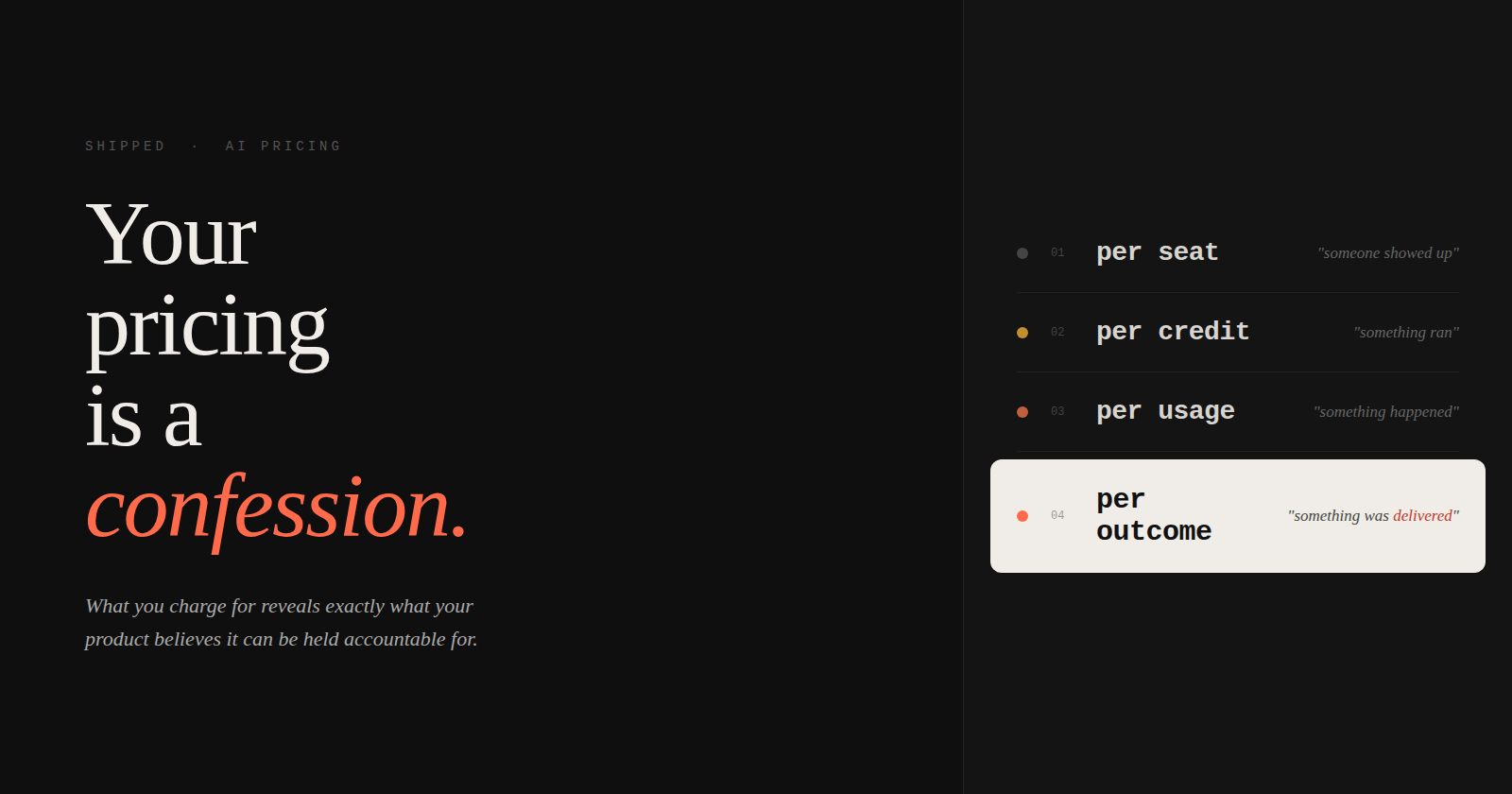
The gap between “AI-native” positioning and seat-based pricing isn’t a lag. It’s a signal. What you charge for reveals exactly what your product believes it can be held accountable for.

↳ This piece was sparked by Everest Group’s “The AI-native pricing paradox in SaaS” — a sharp analysis of why AI-positioned products keep defaulting to seat-based billing. Worth reading alongside this.
Nearly every B2B SaaS product built in the last three years claims to be AI-native. The landing pages say so. The pitch decks say so. The sales calls say so. And then you look at the pricing page, and there’s a per-seat tier, an AI add-on at $X/month, and a “contact us” for enterprise.
Everest Group recently called this out directly: most AI-native platforms are still running on pricing infrastructure that looks like 2018 SaaS with an inference layer bolted on. They frame it as a transitional state — a market working through a shift in economics and value realization. That’s fair. But I think there’s a more pointed way to read the same data.
Your pricing model is a confession. It tells the market — and your team — exactly what you believe your product can deliver and be held accountable for. And right now, most AI products are confessing something they probably don’t want to admit out loud.
The Accountability Spectrum
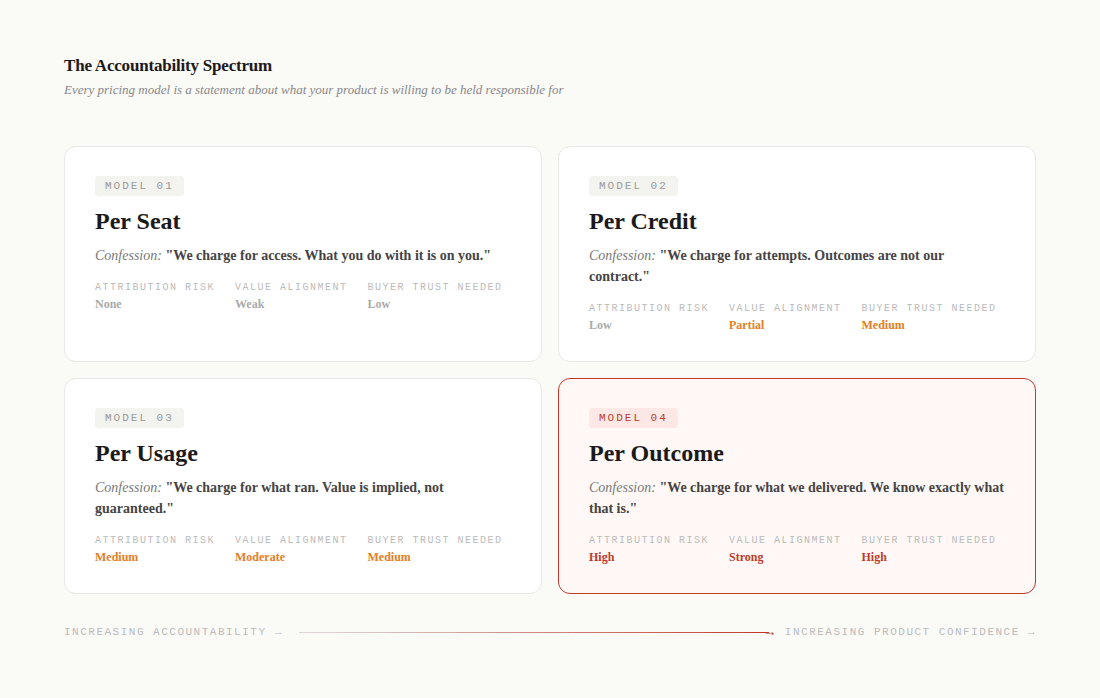
Think about what each pricing model actually says about your product’s self-image.
Seat-based pricing says: “We charge for access. What happens after login is between you and the software.”
Per-credit pricing says: “We charge for attempts. Whether they worked is not our contract.”
Per-usage pricing says: “We charge for what ran. Value is strongly implied.”
Outcome-based pricing says something different entirely: “We charge for what we delivered, and we know exactly what that is.”
Each step up the stack requires solving a harder problem. Not a harder technology problem — a harder epistemic one. You have to know what you’re actually doing for the customer with enough precision that you can name it, measure it, and stake revenue on it.
A16z’s December 2024 analysis put numbers to this. AI-native companies like Decagon have leaned into outcome and usage models — per-resolution, per-conversation — while established platforms with AI bolted on have largely stuck with bundled seat licenses. The divergence isn’t accidental. It reflects exactly the epistemic gap: AI-native builders designed their products around a specific unit of value from day one. Incumbents added AI to products built around a different value unit, and repricing means potentially exposing a mismatch they’d rather not surface.
Why Credits Are a Coping Mechanism
The current dominant landing spot for AI products — a platform fee plus a credit bucket — makes complete sense when you understand what it’s solving for. Metronome’s 2025 field report, which interviewed pricing leads across major AI-native companies, put it bluntly: “We’re not monetizing AI to juice revenue. We’re monetizing to avoid eating $10k of costs on a $500 plan.”
“Credits gave us breathing room while we figured out the real value metric. But they’re not intuitive to buyers.”
That’s a direct quote from a director of monetization at a horizontal SaaS vendor. It captures the honest truth about credits: they’re a defensive mechanism that protects margins during a period of uncertainty, not a statement about value. Customers don’t really understand what a credit does — and neither, frankly, does the product team have a clean answer for why one action costs three credits and another costs twelve.
Intercom’s Fin AI is one of the clearer case studies in what happens when you actually commit to the outcome model. They abandoned per-seat pricing for a per-resolution model at $0.99 per AI-resolved conversation. Within six months: 40% higher adoption, maintained margins despite variable costs, and enterprise customers reporting 60% support cost reductions. When Gartner forecasts that at least 40% of enterprise SaaS spend will shift to usage-, agent-, or outcome-based pricing by 2030, they’re pointing at the pressure building behind stories like Intercom’s.
The Readiness Problem Nobody Talks About
Here’s what gets glossed over in most pricing conversations: outcome-based pricing isn’t just a packaging decision. It’s a product architecture decision made early, or not at all.
To charge per outcome, you need four things in place that most AI products don’t have at the time they first go to market. First, you need a precise definition of the outcome itself — not “the call went well” but “the deal advanced to next stage” or “the ticket was resolved without escalation.” Vague outcomes can’t be priced. Second, you need attribution infrastructure that isolates your contribution from the rest of the system — the human judgment, the other tools, the underlying data. Third, you need contractual clarity, because outcome definitions live in contracts, and enterprise legal teams will make your life difficult if they’re fuzzy. And fourth — this is the one that kills the most companies — you need a narrow enough product scope that your impact can actually be isolated.

Most AI products are horizontal by design — they work across multiple workflows, verticals, and use cases because TAM expansion is rewarded by investors. But horizontal products have diffuse impact. Diffuse impact is hard to attribute. Hard attribution makes outcome pricing nearly impossible to implement fairly. This is not a temporary lag. It’s a structural constraint that many products will never escape without meaningfully narrowing their scope.
What Moving Up the Ladder Actually Requires
Bessemer’s 2026 AI pricing playbook frames it this way: “Client-server monetized licenses. SaaS monetized access. AI will monetize outcomes.” That’s the arc. But the journey from access to outcomes isn’t automatic — it requires a specific kind of product discipline that most teams don’t build because they’re busy shipping features.
The products that will move fastest toward outcome models share a few patterns. They have tight feedback loops — they know within one session whether the AI delivered something useful or not. They instrument for value metrics before they instrument for engagement metrics. And critically, they designed their scope constraint intentionally: they picked a specific problem they could fully close the loop on, even if it meant passing on adjacent use cases.
If you’re currently on seat or credit pricing, the question isn’t “how do we move to outcome pricing?” The question is “what would we need to know — and build — to make that move credible?” That’s a product roadmap question more than a pricing strategy question. And most teams who answer it honestly find they’re further from outcome pricing than the positioning suggests.
The Everest Group is right that pricing will continue to look transitional for the foreseeable future. But the reason isn’t market immaturity or buyer resistance, though both are real. It’s that outcome-based pricing requires a product that can tell the truth about what it does. And a lot of AI products aren’t there yet — not because the technology isn’t good enough, but because the measurement infrastructure isn’t in place.
Your pricing model will catch up to your positioning eventually. The question is whether you’re building toward that convergence deliberately, or just waiting for it to happen.
The author is building Auron — an AI-powered voice and conversation intelligence platform that captures and enriches organizational knowledge from meetings, calls, and conversations. Auron turns every interaction into structured signal that teams can act on.