
The Wisdom Your Model Can’t Train On
Every rep on your team has access to the same foundational AI. The question is what they bring to the conversation that the model alone cannot — and how you make sure that advantage is shared across.

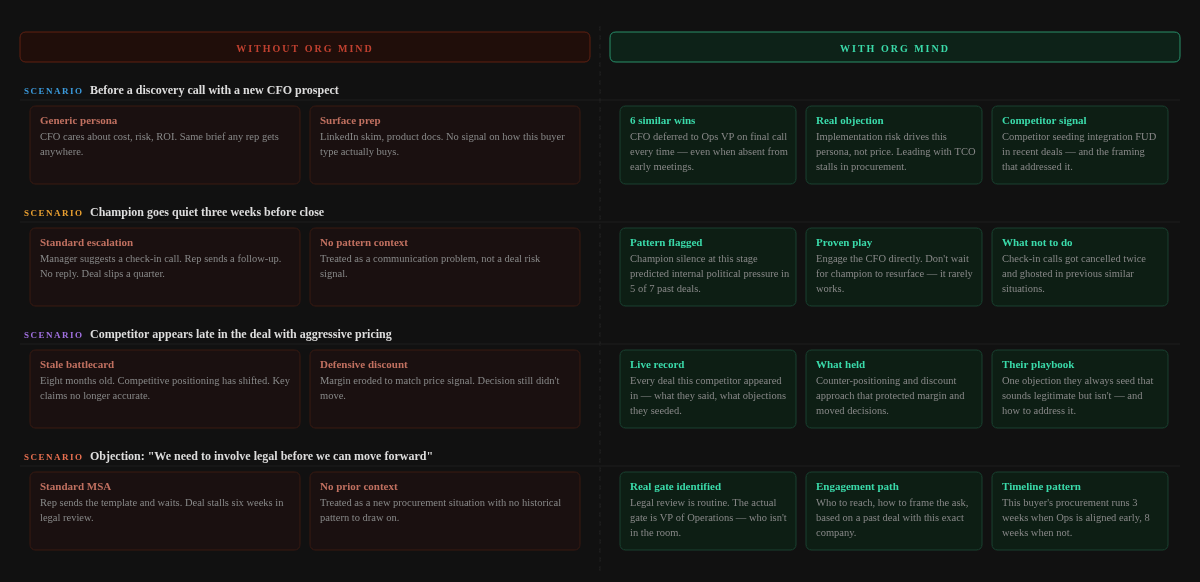
Picture a rep thirty minutes before a discovery call with the CFO of a mid-market manufacturing company. She opens her AI assistant and asks what she should know going in. The model responds with confidence: CFOs typically care about cost, risk, and ROI timelines. Common objections are budget and timing. Lead with total cost of ownership.
It’s not wrong. It’s also exactly what every other rep at every other company gets when they ask the same question. The model draws from a vast training corpus of public knowledge — analyst reports, sales blogs, persona frameworks, case studies. It gives her the industry-level view. What it cannot give her is what her organization has specifically learned from selling into this exact buyer profile, in this market, over the past two years.
That’s the gap the organizational mind fills. Not a different AI, not a better prompt — a different layer of context sitting between the model and the query. One built from the aggregate judgment of every person in the organization who has touched a similar deal.
What the org mind actually knows
The organizational mind is not a CRM or a knowledge base. It’s the accumulated intelligence that emerges when you treat every conversation your team has — every discovery call, every deal review, every won and lost debrief — as a source of signal rather than an event that passes and is forgotten.
That rep asking about the CFO call doesn’t need the generic persona. She needs to know that in your last six wins with this buyer type, the CFO consistently deferred to the VP of Operations on the final decision — even though Operations wasn’t in any of the early calls. She needs to know that this buyer type fixates on implementation risk, not price, and that leading with TCO tends to trigger a procurement process that stalls for months. She needs to know that a competitor has been seeding a specific doubt about your integration capabilities in two recent deals, and the framing that has successfully addressed it.
None of that is in any public corpus. All of it is in your organization’s collective experience — if you have a way to capture it.
Through the full arc of a deal
The value of the organizational mind isn’t a single moment of preparation before a call. It runs through every stage of how a deal actually unfolds.
In discovery, most reps ask reasonably good questions. The org mind raises the ceiling on what good looks like. It knows which questions consistently exposed real budget signals in past deals. It knows which personas in this vertical tend to give optimistic timelines that never hold. It knows the one framing that, across fifteen discovery calls, reliably got the prospect to talk about their actual internal pressure rather than the stated business case.
During champion development, the org mind knows what champion silence looks like in your deals — specifically. Not in the abstract sense that sales methodology teaches, but in the concrete sense of: when a champion at this type of company goes quiet three weeks from close, it has predicted internal political pressure in five out of seven similar situations. The play that worked: engage the CFO directly rather than waiting for the champion to resurface. The play that didn’t: a check-in call that the champion cancelled twice and then ghosted.
In multi-stakeholder situations — which is most enterprise deals — the org mind knows who the real gate tends to be. Not who says they’re the decision-maker, but who has actually held up or accelerated deals like this one in the past. It knows how Ops and Finance tend to frame the ROI question differently, and which framing to lead with depending on who’s in the room.
When late objections arrive — and they always do — the org mind distinguishes between the objections that are genuine concerns and the ones that are delay tactics. It knows, from your own deal history, which objections at this stage preceded a close and which preceded a loss. It knows which responses moved deals forward and which extended the cycle without improving the outcome.
The model gives every rep the industry view. The org mind gives your reps what your team specifically learned from doing this — and there’s no substitute for that distinction.
Where it changes outcomes, concretely
The abstract case for organizational intelligence is easy to make. The concrete case is more useful.
The champion going quiet scenario is worth dwelling on. Without the org mind, a rep notices the silence, escalates to their manager, gets the advice to do a check-in call, sends an email that goes unanswered, and watches the deal slip. This happens on every team, repeatedly. It’s not a failure of individual skill — it’s a failure of pattern recognition. The pattern exists in the organization’s history. The rep just doesn’t have access to it.
The competitive situation is similarly instructive. Battlecards get created at a point in time and then slowly decay as competitive dynamics shift. The rep who falls back on an eight-month-old battlecard when a competitor shows up late in a deal is not making a bad decision — they’re making the best decision available to them. The org mind is a living competitive record: every deal where that competitor appeared, what they said, which positioning held and which didn’t. It doesn’t go stale between quarterly updates. It updates every time a rep has a real encounter.
Personal judgment on top
The organizational mind raises what every rep can access. But it’s not the ceiling — it’s the floor.
A rep who has spent two years absorbing the organization’s collective experience, and who has developed their own instincts on top of it, operates at a fundamentally different level. When they query through the org mind before a call, they’re not just reading a briefing. They’re filtering it through their own read of the room, their sense of this specific buyer, their judgment about which patterns apply and which don’t. That combination — the org’s aggregate intelligence plus individual experience — is what separates the good rep from the great one.
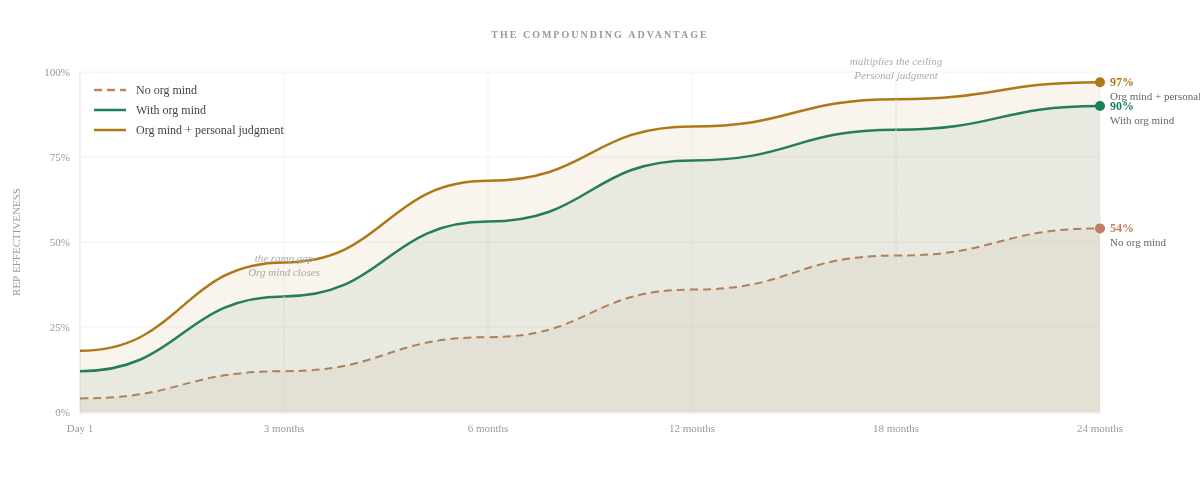
This is why the value of experienced people doesn’t shrink as AI improves — it grows. A new rep with the org mind starts better than a new rep without it. But the experienced rep who has built personal judgment on top of a rich organizational layer doesn’t just have their own experience. They have years of personal pattern-matching informed by the entire team’s collective history. The gap between the two trajectories widens continuously.
A note on continuity
The deal-closing case for the organizational mind is the primary one. But there is a second benefit that follows almost automatically: the intelligence doesn’t leave when people do.
The average enterprise sales rep stays in their role for around 18 months. When they leave, the pattern recognition, the account context, the hard-won instincts — in most organizations, it walks out with them. The organizational mind changes that. The learning stays, because it was never stored in the person. It was captured from the conversations, extracted as signal, and folded into the layer the whole team draws from.
The same applies when a long-tenured expert retires. Someone who has sold into a particular vertical for fifteen years carries context that is genuinely irreplaceable in human terms — but not in organizational terms, if that context has been systematically captured.
These are real benefits. They’re just not the main reason to build the organizational mind. The main reason is simpler: it makes your reps better at closing deals, starting now, in every conversation they have.
What this actually requires
For most sales organizations, the instinct is to solve this with process — mandatory call notes, structured deal reviews, updated battlecards, post-mortems on lost deals. These are not bad ideas. They also don’t work at the fidelity the org mind requires, because they depend on individual discipline and self-reporting, and because what gets written down is always a sanitized summary rather than the real texture of what happened.
The organizational mind is built from the judgements people already form — but rarely articulate in a way that persists. A rep walks out of a discovery call knowing something they didn’t know going in. A deal closes and the AE understands, in their gut, exactly what tipped it. A loss happens and someone on the team knows precisely why, even if the CRM record says ‘lost to competitor on price.’ That knowledge exists. The problem is it stays private.
The mechanism that changes this isn’t an agent passively extracting from recordings. It’s the rep themselves reflecting — prompted, after the fact, by a voice agent that asks the right questions and knows what to draw out. What shifted in that call? What objection surprised you? What did the champion say when you pushed back? The intelligence emerges from the human’s own reflection. The voice agent is the structure that makes that reflection happen consistently, and the means by which what surfaces gets folded into the layer everyone else draws from.
It’s also a different kind of advantage. Every team has access to the same models. Every team can prompt their way to a reasonable CFO persona brief. The organizational mind is what separates that generic answer from one that reflects two years of your team’s actual experience — the wins, the losses, the moments someone noticed something that never made it into a slide deck. That distinction doesn’t exist in any public training corpus. It only exists inside your organization, surfaced by the people who lived it.
The author is building Auron — an AI-powered voice and conversation intelligence platform that captures and enriches organizational knowledge from meetings, calls, and conversations. Auron turns every interaction into structured signal that teams can act on.