
The Skills Trap: Why Building Your Own Is the Only Thing That Compounds
Everyone is sharing AI skills. Almost nobody is asking whether using them is actually making you better — or when borrowing is perfectly fine.

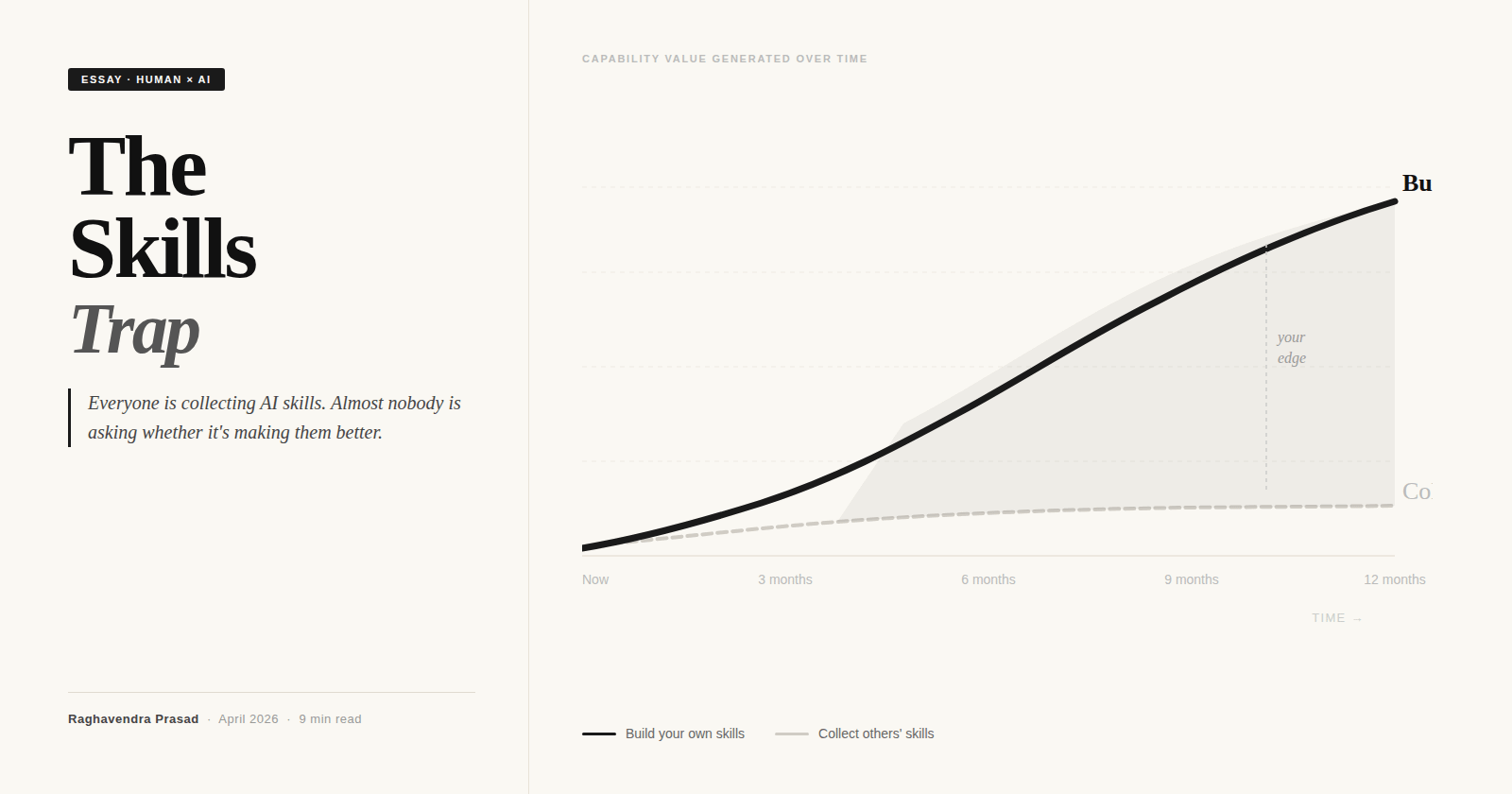
Every week, someone publishes a new list. “37 AI skills that will change how you work.” “The 58 best skills for productivity.” People collect these like they once collected browser bookmarks — enthusiastically, and with very little follow-through.
Here’s what nobody is actually saying: consuming other people’s skills is not the same as building capability. But the full picture is more nuanced than that. There are situations where borrowing a skill from the web and getting 60% of the way there is entirely the right call. The question isn’t build vs. borrow — it’s knowing when each applies.
What Is a Skill, Really?
Anthropic, which introduced Agent Skills as a core capability in Claude, defines them clearly: skills are modular, reusable sets of instructions and resources that Claude loads dynamically to perform better at specific tasks — structured knowledge that transforms a general-purpose model into a specialist.
📘 How Anthropic Defines It From the Anthropic engineering blog: building a skill is like putting together an onboarding guide for a new hire. Skills transform general-purpose agents into specialists — tuned to your needs, not someone else’s approximation of them.
A skill has anatomy. It has intent baked into it. A skill built by someone else was built for their workflow, their mental models, their definition of a good output. When you pick it up, you inherit all of that — including the parts that don’t fit you, the assumptions you can’t see, and the blind spots you can’t audit.
A skill is only as good as the thinking that went into it. If that thinking wasn’t yours, the value has a ceiling — and you can’t see it.
The Skill Fidelity Spectrum
Here’s where most conversations about AI skills go wrong: they treat it as a binary. Build everything yourself, or borrow everything from the web. Reality is a spectrum — and the right call depends on what you’re actually trying to do.
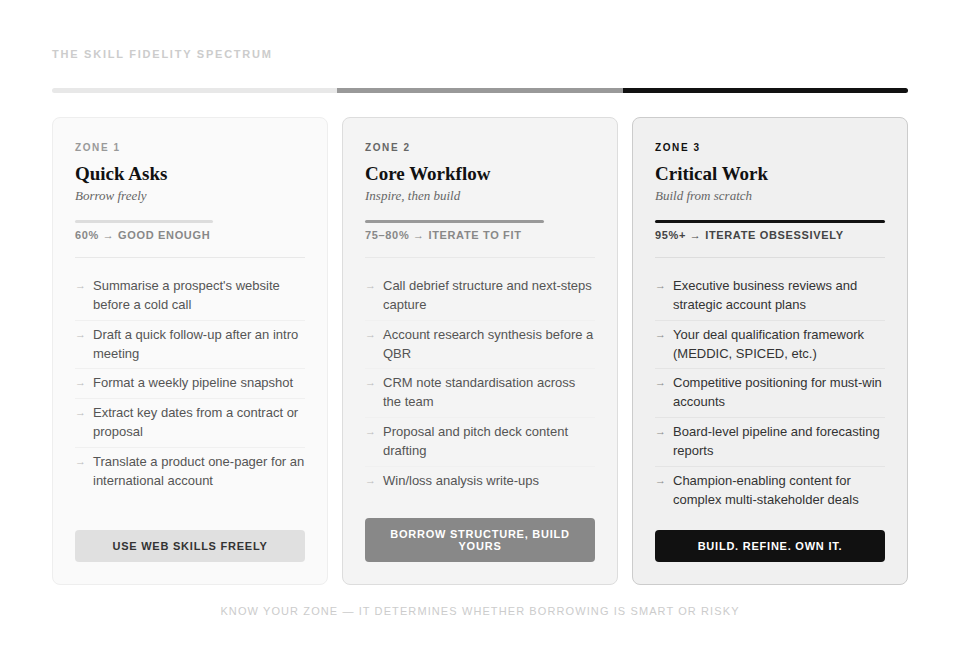
Zone 1 is where speed wins. Summarising a prospect’s website before a cold call, drafting a follow-up after an intro meeting, extracting key dates from a contract — the bar here is “good enough and fast.” Grabbing a shared skill from the web is perfectly rational. The cost of building your own outweighs the marginal gain from perfection. Take the 60%. Move on.
Zone 2 is where you start to feel the limits of borrowed skills. Your call debrief structure, how your team synthesises account research before a QBR, how CRM notes get standardised — these have specific quirks that a generic skill won’t accommodate. This is where you take a shared skill as a starting point, understand its structure, understand why it’s built that way, and then build your own version on top. The shared skill is a scaffold, not a solution.
Zone 3 is non-negotiable. If the output is an executive business review, a strategic account plan for a must-win deal, your qualification framework, or board-level pipeline reporting — 60% is not good enough. A generic skill won’t know your methodology, your competitive positioning, or how your champion needs to sell the deal internally. You need something built for exactly your context, refined across real opportunities. There are no shortcuts here, and borrowing one is a liability disguised as efficiency.
The False Promise of the Shared Skill
The appeal of borrowing is obvious. But for anything outside Zone 1, the logic starts to break down.
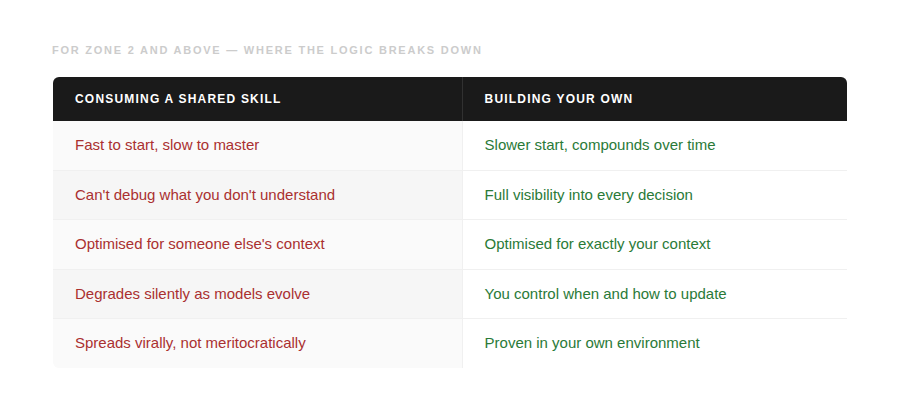
Shared skills spread because they look impressive — not because they work well for every use case. That’s noise with social proof attached. The more you rely on them for Zone 2 and Zone 3 work, the less you develop the judgment to evaluate whether they’re actually delivering.
The Risks Nobody Is Talking About
For any skill that matters — Zone 2 and above — the risks of not building your own are real and compounding.
Black Box Dependency — You can’t debug what you don’t understand. When outputs drift, there’s no thread to pull. You’re flying blind inside someone else’s cockpit.
Silent Degradation — Models evolve. Skills built for last quarter’s model decay quietly. You keep using something eroding, with no signal that anything’s wrong.
Cognitive Atrophy — Not building has a cost. You stop asking “what do I actually want here?” You outsource the thinking — precisely the part where capability lives.
Inherited Blind Spots — Every skill encodes its builder’s assumptions. Their constraints and gaps become yours — invisibly, without consent, impossible to audit.
⚠️ Anthropic’s Own Warning Anthropic’s official Agent Skills documentation states explicitly: “We strongly recommend using Skills only from trusted sources: those you created yourself or obtained from Anthropic.” Malicious or poorly built third-party skills can lead to data exfiltration and unauthorized system access. The platform creator is telling you: know what you’re running.
Inspiration Without Dependency
Anthropic’s own open-source skills repository exists precisely as a reference — patterns and possibilities to learn from, not a catalogue to wholesale adopt. That’s the right mental model for anything you find in the wild.
The distinction is between inspiration and adoption. Look at what others built to understand the technique. Then close the tab and build your own. — The chef’s approach
A good chef studies someone else’s recipe to understand the logic behind it — the technique, the balance, the sequencing. They don’t serve it at their restaurant and call it their cooking. They internalise the principle and build something genuinely theirs. That’s the right relationship to shared skills for anything beyond quick asks.
Anatomy Over Acquisition
The most transferable capability in AI right now is understanding the anatomy of a skill — what makes one work, what makes one fail, how structure and specificity interact to produce quality outputs. Anthropic’s prompt engineering documentation and their interactive tutorial are the best places to build this foundation.
✅ The Core Principle Zone 1: borrow freely, 60% is fine. Zone 2: borrow structure, build your own version. Zone 3: build from scratch, iterate obsessively. Personalization is the only sustainable edge — and it only compounds when you’ve done the thinking yourself.
The Approach That Compounds
Know your zone before you act. Before reaching for a skill — yours or anyone else’s — ask: is this a quick ask where speed wins, core workflow where fit matters, or critical work where only precision counts? The zone determines the approach.
For Zone 1 — take and go. Quick asks don’t need custom skills. Summarising a prospect’s website or formatting a pipeline snapshot? Use what’s available, accept the 60%, move on. The ROI of building a bespoke skill for throwaway tasks is almost never positive.
For Zone 2 — inspire, then own. Find a well-structured skill for your call debrief or account research process, understand every element of why it’s built that way, then rebuild it for your methodology. Don’t ship the scaffold — ship what you built on top of it.
For Zone 3 — build, iterate, never stop. Your deal qualification framework, your strategic account plan structure, your board-level pipeline narrative — these start from your own thinking. Version one will be imperfect. Version five will be irreplaceable. The iteration cycle is where understanding deepens, and where the compounding starts.
The people skimming “58 best AI skills” threads are collecting. Some of that is fine — for Zone 1, collecting is rational. But the people who will pull ahead are the ones who know where the line is, build deliberately for the work that matters, and compound that understanding over time. Both approaches feel productive. Only one of them actually is.
The author is building Auron — an AI-powered voice and conversation intelligence platform that captures and enriches organizational knowledge from meetings, calls, and conversations. Auron turns every interaction into structured signal that teams can act on.