
The Onboarding Problem with AI Products
When a user walks away from your AI feature confused, disappointed, or suspicious — you have failed at the most basic job of the product builder: setting honest expectations before asking for trust.

There is a moment, familiar to anyone who has shipped an AI feature, when you watch a user interact with your product for the first time and realize they are having a completely different experience than the one you designed. They typed something perfectly reasonable. Your model responded with something technically accurate. And yet the user stares at the screen, unmistakably disappointed — and then closes the tab. No feedback. No second attempt. Just gone.
This moment is not an edge case. It is the norm. And it is almost never caused by a bad model, a broken prompt, or a latency issue. It is caused by a gap between what the user expected and what the system was ever capable of delivering. That gap — invisible to you in development, devastating to the user in production — is your responsibility to close. Not the model vendor’s. Not the infrastructure team’s. Yours.
Why Expectation Management Is Not a “Nice to Have”
The popular framing of onboarding in AI products is UX-as-tutorial: a guided walkthrough, a tooltip cascade, maybe a short video. Teams check the box — “we have onboarding” — and move on to building features. But this fundamentally misunderstands what onboarding is for when AI is in the picture.
Onboarding for traditional software features is about discoverability and mechanics. Show the user where the button is; explain what clicking it does. The behavior is deterministic. Users quickly develop a mental model because the feature always behaves the same way given the same input.
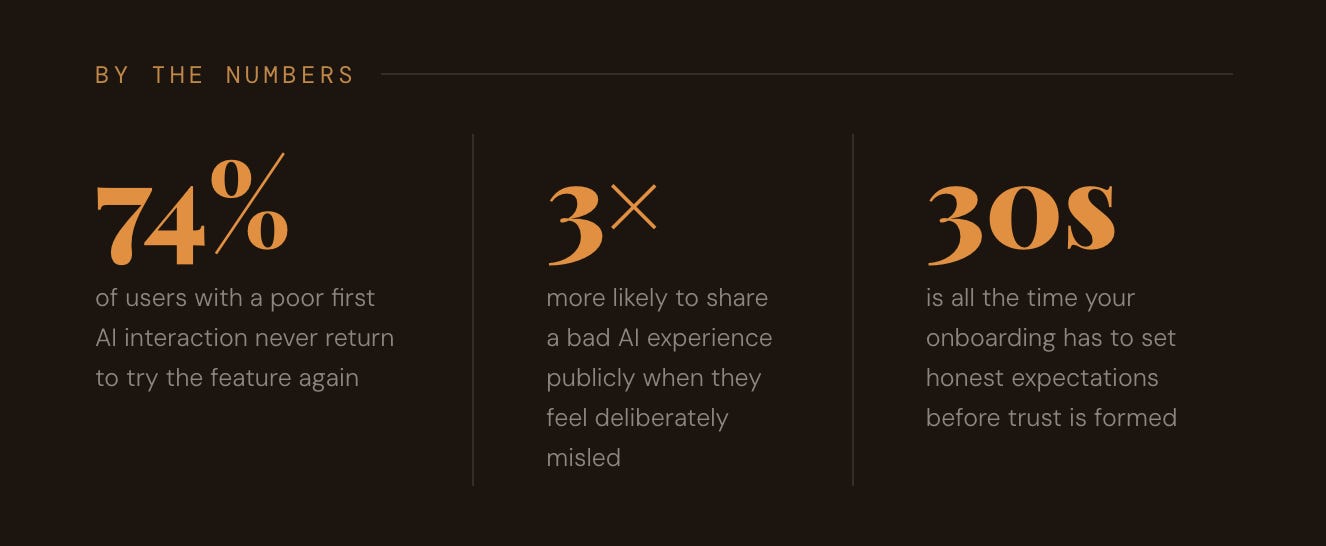
AI features are not deterministic. They are probabilistic, context-sensitive, and bounded in ways that are not intuitive to non-technical users. A user who has spent years using Google Search has a clear mental model of what a search engine is: type words, receive links ranked by relevance. That model took decades to build through billions of consistent interactions. Your AI feature does not have decades. It has the first thirty seconds of someone’s attention, and then whatever impression survives the first two exchanges.
If the user’s mental model of your feature is wrong — if they believe it can do things it cannot, or are unaware of what it actually excels at — you have not just failed at UX. You have poisoned the well for every subsequent interaction. You have created a user who will eventually discover the mismatch, feel deceived, and attribute the deception not to ignorance but to you. Because you had the information. You knew the constraints. And you said nothing.
Users do not arrive as blank slates. They arrive carrying expectations, sci-fi tropes, and LinkedIn posts about AI doing everyone's job. Your feature will be judged against all of it before it answers a single question.
The Expectation Debt Accumulates Before They Even Log In
Here is the uncomfortable reality of building AI products in 2026: your users have already formed an opinion about what AI can and cannot do before they encounter your product. Their priors are shaped by OpenAI and Anthropic’s announcements, viral demos on X, enterprise case studies that cherry-pick the best outputs, and cultural narratives that oscillate between “AI will do everything” and “AI is a stochastic parrot that hallucinates constantly.”
These priors are almost never calibrated to the specific capabilities of your specific feature. They are either too optimistic or too pessimistic, and rarely in a useful direction. A user who has seen impressive demos will expect your document intelligence feature to magically understand context from three years ago. A user who has read sceptical coverage will ask deliberately trick questions to catch the system lying.
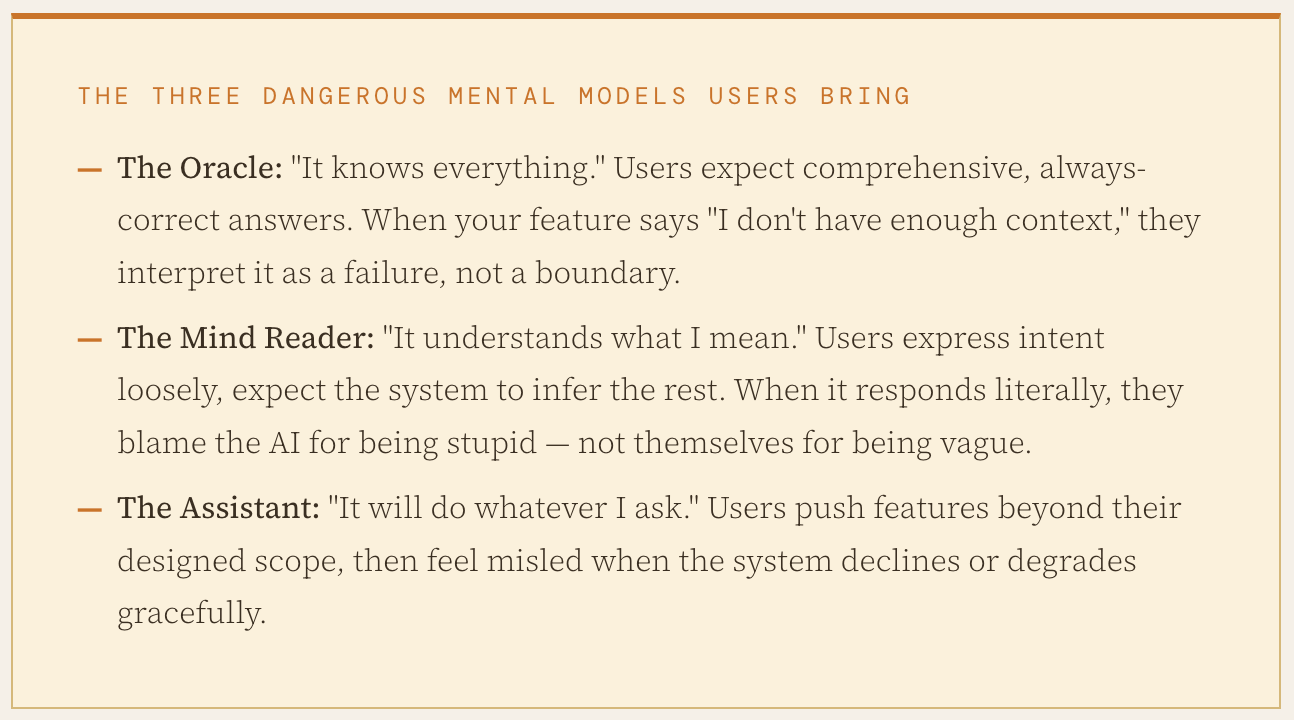
None of these mental models are unreasonable given the noise users are exposed to. What is unreasonable is a product team that ships an AI feature without actively addressing all three. You cannot control what users read on the internet before they open your app. You can absolutely control what they understand within the first minute of using it.
The Four Ways Product Teams Fail at This
After examining dozens of enterprise and consumer AI product launches, the failure modes cluster around four recurring patterns. Each one feels justifiable in the moment. Each one costs real user trust.
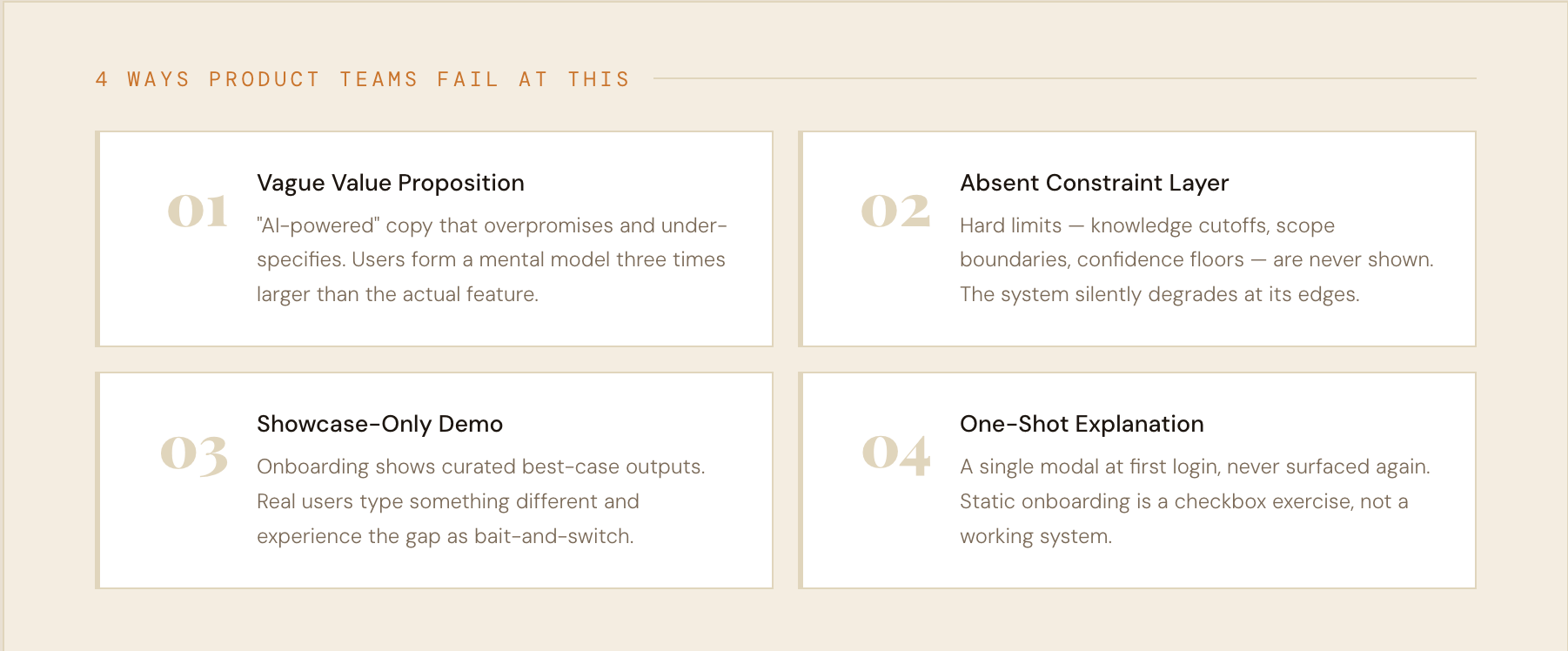
The Vague Value Proposition
Marketing copy that says “AI-powered” or “intelligent insights” but communicates nothing about what the feature actually does, or more importantly, what it doesn’t do. When the product team is proud of a capability, there is enormous pressure to describe it in the most expansive possible terms. The result is users with a mental model that is three times larger than the actual feature — and a corresponding drop-off when reality arrives.
The Absent Constraint Layer
Features that have hard limitations — scope boundaries, data freshness windows, confidence thresholds — but surface none of them to the user. The system just silently degrades, or worse, confidently produces an answer at the boundary of its competence where it is least reliable. Users experience this as erratic, untrustworthy behavior. The feature’s reputation collapses before the team even notices the pattern in support tickets.
The Showcase-Only Demo
Onboarding that shows the system at its best: carefully curated examples where the model produces clean, impressive output. Real users rarely type the example prompts. They type what they actually need, which looks nothing like the demo. The mismatch between the curated showcase and their actual first experience creates immediate disillusionment — the gap between the demo and reality is interpreted as bait-and-switch, even when it wasn’t intended that way.
The One-Shot Explanation
A single tooltip or modal at first login that explains the feature in broad strokes, then disappears forever. Users don’t absorb everything in a first-contact explanation. They need context to be surfaced progressively — when they are about to make a mistake, when they are clearly trying to use the feature beyond its scope, when they are not getting value from a workflow that could be better. Static onboarding is a checkbox exercise. Dynamic, contextual guidance is actually useful.
Trust Damaged by AI Is Harder to Repair Than Trust Damaged by Software
When a traditional software feature fails — a button does the wrong thing, a form doesn’t submit — users understand the category. Software has bugs. Software gets fixed. The user waits for an update, or files a support ticket, or works around it. The failure is localized, mechanical, and external to the user.
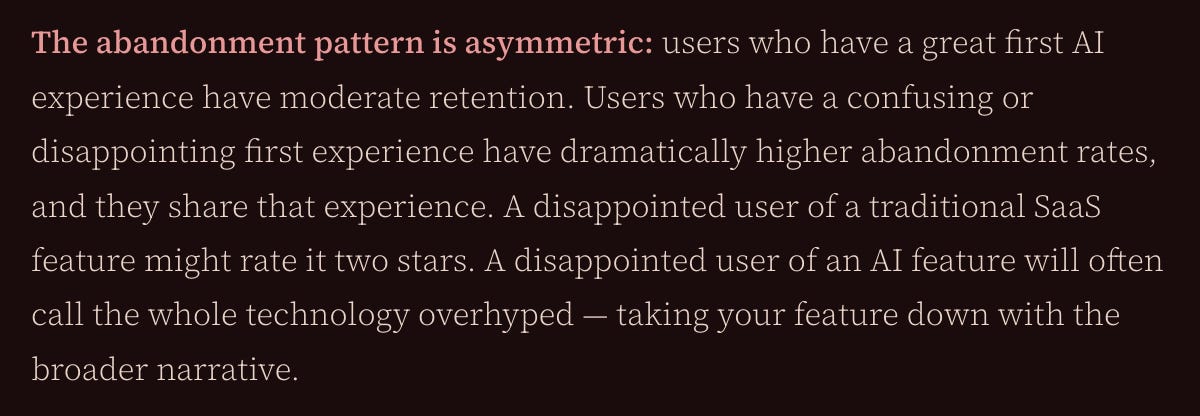
When an AI feature fails, the failure is often ambiguous. Did the system misunderstand the question? Did the user ask wrong? Is the model just bad? Is it hallucinating? Is the feature simply not designed for this? Users can’t easily distinguish between these. And because AI features are associated with intelligence, a failure often implicates the user’s own clarity of thought in a way that a broken button never would. “Maybe I asked it wrong.” This ambiguity is deeply uncomfortable. Users resolve it by withdrawing.
What Good Onboarding for AI Features Actually Looks Like
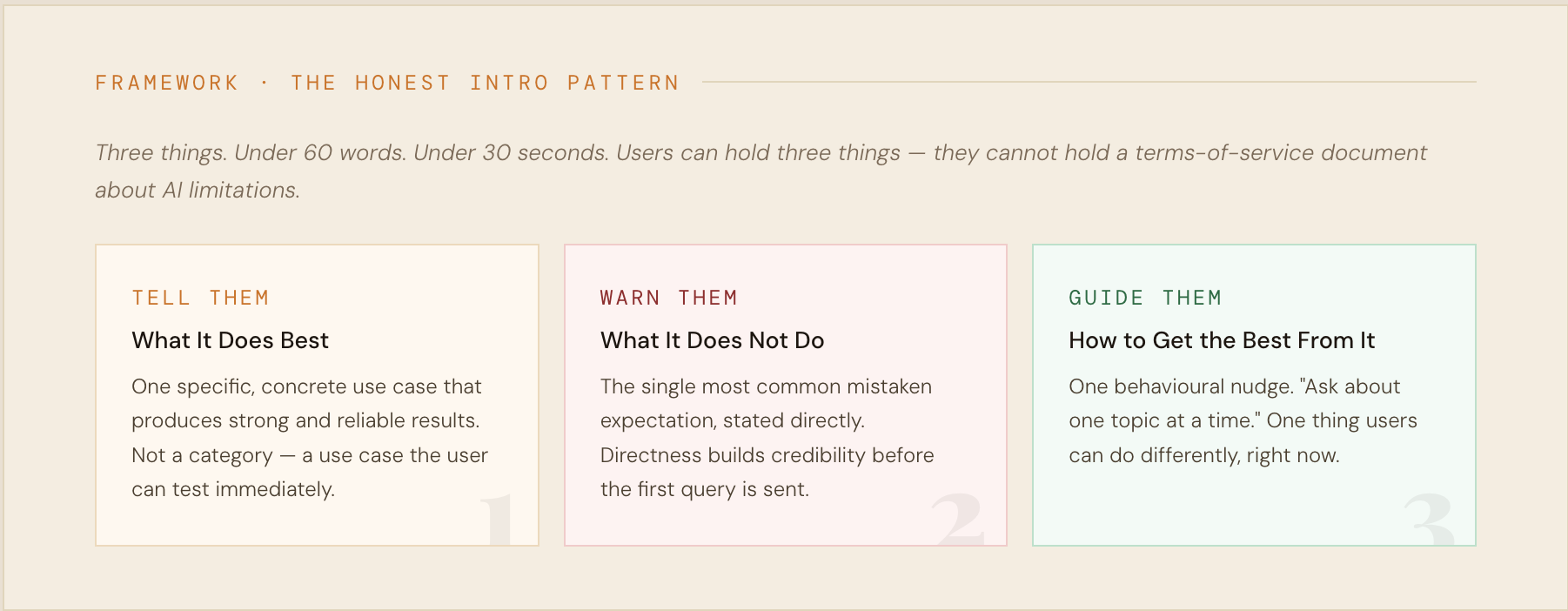
The premise is not complicated: be honest about what the feature is, show users how to get real value from it, and surface constraints before they become disappointments. The execution requires more care than most teams invest, but it is not a research problem. It is a prioritisation problem.
Specificity over aspiration
Describe what the feature does in concrete, observable terms. Not “understand your documents” but “extract action items and decisions from meeting transcripts, with source attribution.” Not “answer your questions” but “answer questions about calls completed in the last 90 days, based on extracted signals.” Specificity is not a limitation on your marketing. It is a filter that ensures the users who engage are users who can actually get value — and it sets a fair contract before the first interaction.
Surface the envelope early
If your feature has a knowledge cutoff, say it. If it cannot process certain file types, say it before the upload fails. If it performs significantly better with structured questions than open-ended ones, show users what that looks like. Users who understand the envelope stop trying to break through it. Users who don’t understand the envelope will probe edges constantly — and they’ll find every weakness you have.
Design for the wrong query
Most onboarding is designed for users doing things right. Great onboarding is designed for users doing things wrong. When a user submits a query that falls outside your feature’s scope, that moment is a onboarding opportunity, not a failure state. A response that says “That’s outside what I can help with here — I work best when you ask about X, Y, or Z” teaches the user something real. It resets expectations in context, at the moment of failure, which is when people are most receptive to recalibration.
If your system instead returns a degraded output confidently — answering a question it shouldn’t attempt, producing something plausible-looking but unreliable — you have compounded the problem. The user who receives a confident wrong answer has formed a worse mental model than the user who received no answer at all.
Let users build a mental model through guided exploration, not passive consumption
The research on how people learn new tools is unambiguous: active exploration beats passive instruction. Showing users a tour of capabilities does less than asking them to try a specific thing and succeed. Design the initial experience so that the user’s first interaction is almost guaranteed to produce a good output — not because you’ve hidden the limitations, but because you’ve funnelled them into the use case where your feature genuinely excels. Let them win first. Teach them the boundaries after they’ve experienced the value.
This sequencing matters enormously. A user who has already experienced something valuable from your feature will interpret a subsequent failure as a boundary. A user who encounters a boundary before they’ve felt any value will interpret it as a verdict.
The Deeper Obligation: You Know More Than the User
There is an ethical dimension to this that the product industry tends to avoid because it makes business people uncomfortable. When you ship an AI feature, you know things the user does not: the model’s failure modes, the training data boundaries, the confidence calibration, the edge cases your evaluation caught during development. The user knows none of this. They are trusting the interface — and by extension, you — to be honest with them about what they are dealing with.
This information asymmetry is not an excuse to be vague about limitations for the sake of a better conversion rate on the feature adoption funnel. It is an obligation. You are not selling a car with known braking defects and hoping the driver stays on dry roads. The stakes are lower, but the structure of the ethical problem is the same: you have relevant information that materially affects the user’s ability to make good decisions with your product. Withholding it in the service of a cleaner onboarding conversion metric is a choice with consequences.
Users who feel deliberately misled by an AI feature are three times more likely to share that experience publicly than users who simply found the feature underwhelming. Disappointment is private. Feeling deceived is social.
The long-term business case aligns with the ethical one, which is convenient but also real. User trust is compounding. A user who has an honest, calibrated experience with your AI feature — who understands what it is, uses it appropriately, and gets genuine value — will expand their usage over time, advocate for the tool internally, and forgive the inevitable edge cases. A user who felt misled will cancel, churn, and tell colleagues. In enterprise software, that conversation happens in a single Slack channel and reaches the renewal committee.
The Onboarding Frame Is Too Small for This Problem
One final observation: “onboarding” is probably the wrong frame for what we’re discussing. Onboarding implies a finite process — something a user goes through once, at the beginning, after which they are “onboarded.” The expectation management problem in AI features is not finite. It is continuous.
Models change. Capabilities expand. New limitations surface under new usage patterns. A user who was correctly calibrated six months ago may be miscalibrated today because you shipped a new version without communicating what changed. A feature that worked well for three-person sales teams starts behaving differently at fifty seats because the context requirements scale differently than the team assumed.
Good expectation management for AI products is a living system, not a launch checklist. It requires changelogs written for users, not engineers. It requires in-product signals that detect when users are hitting boundaries they don’t understand. It requires a product culture that treats “user had wrong expectations” as a product bug, not a user error. This is harder. It is also the only version that scales.
The irony of the AI onboarding problem is that the tools to solve it are straightforward. Clear copy. Honest constraints. Contextual guidance. Feedback loops that surface when users are confused. None of this requires a breakthrough in UX research or a new design pattern. It requires the discipline to slow down before shipping and ask the question that too many teams skip: What will a reasonable user expect from this, and how much of that expectation is accurate?
If the answer is “less than half,” you have work to do before the launch, not after. If the answer is “we’re not sure,” that is also useful information — and it’s telling you that the team has spent more time benchmarking model outputs than understanding users. Both matter. Right now, at most companies, only one of them is getting the attention it deserves.
Users don’t owe you patience while they figure out what your AI can and can’t do. That is your job. They gave you their attention when they signed up. They gave you their data when they ran their first query. The least you can give them back is clarity about what you built.