
The Loop You Can’t Automate
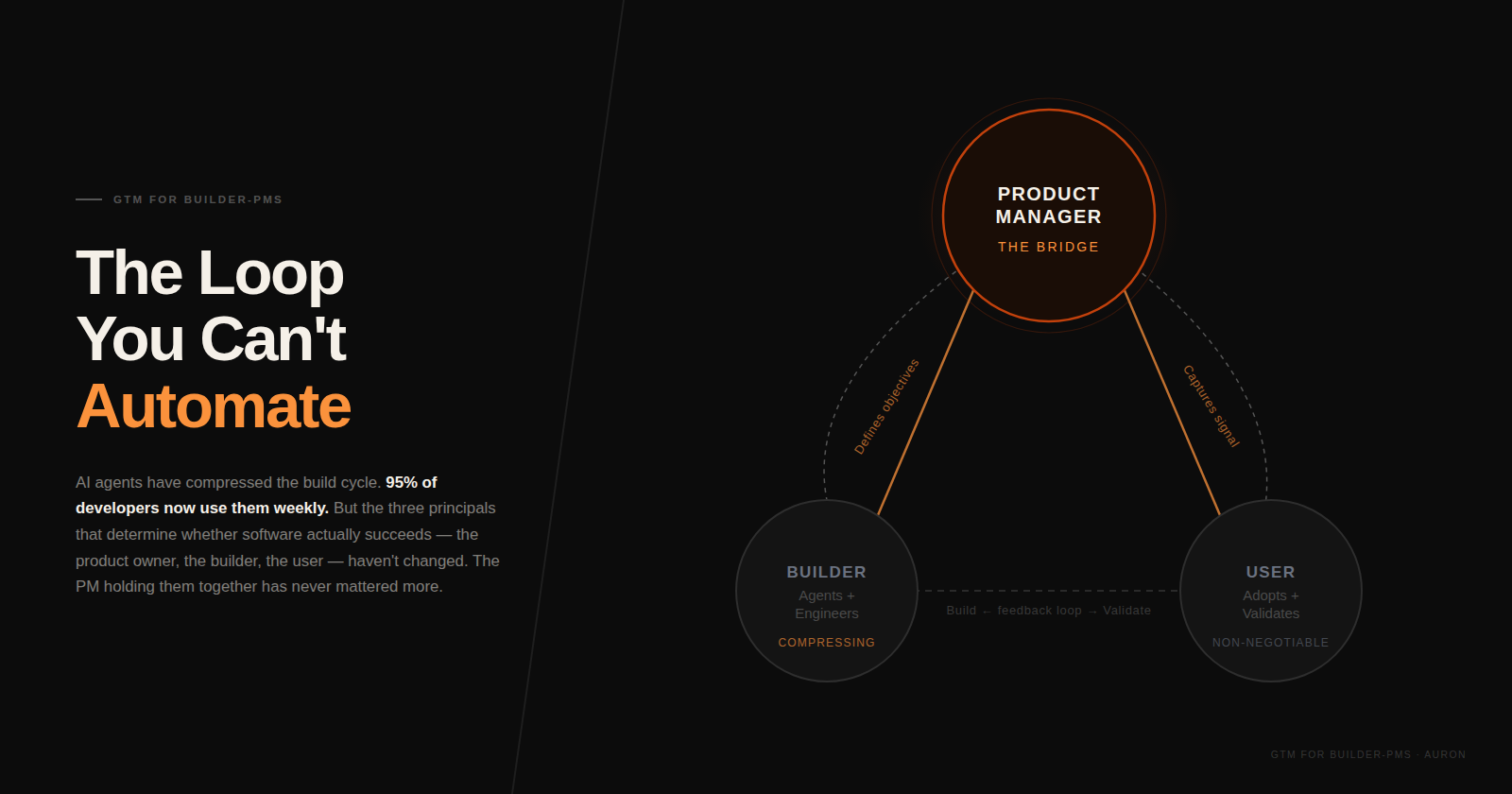
AI agents have compressed the build cycle. What they haven’t changed — and can’t — is the triangle of principals that determines whether software actually succeeds. The product manager holding that tr

The numbers are hard to dismiss. 95% of professional developers now use AI coding tools at least weekly. In February 2026 alone, every major AI coding platform shipped multi-agent capabilities within the same two-week window. Anthropic’s Claude can now sustain autonomous coding sessions for more than 30 hours without meaningful performance degradation. The conclusion most people draw from this is about builders: fewer needed, hierarchy flattening, architecture and evaluation becoming the scarce skills.
All of that is directionally correct. But there’s a dangerous corollary that gets smuggled in underneath it — the idea that because execution is being automated, the product owner can hand objectives to a fleet of agents and let them converge on a result. That the feedback loop from users is a legacy artefact of slow build cycles that can now be designed out.
That conclusion is wrong. And the consequences of acting on it are worse in an AI-accelerated world than they ever were before.
What Is Actually Changing on the Builder Side
The builder hierarchy is genuinely compressing. Employment among developers aged 22–25 fell nearly 20% between 2022 and 2025, according to a Stanford study — coinciding almost precisely with the rise of capable AI coding tools. The roles thinning out first are execution roles: junior developers, manual testers, QA specialists whose primary job was checking that code did what it was supposed to do.
What’s replacing them isn’t just faster code. It’s a structural shift in what skilled builders spend their time on. Engineers describe delegating tasks that are “easily verifiable” to agents — routine implementations, test generation, documentation — while keeping complex, design-dependent decisions for themselves. The builder’s job increasingly becomes architecture, review, and evaluation of agent output. The pyramid doesn’t disappear. It inverts.
But here is what the compression data actually shows, and it’s something that often gets overlooked: a METR research study found that experienced developers using AI tools on complex tasks took 19% longer than without them. Not because the tools are bad — but because the bottleneck on hard problems was never execution. It was definition. Clarity of objective. Knowing what “done” actually means. Agents accelerate the execution of well-defined work. They compound the cost of poorly defined work at the same rate.
Three Principals. None of Them Optional.
There have always been three parties in any product development cycle. They have different names in different organisations — product owner, delivery team, end user; or sponsor, engineering, customer — but the structure is invariant. You have someone responsible for defining what gets built and why. You have someone responsible for building it. And you have someone whose adoption, feedback, and continued engagement is the only true measure of whether anything worked.
The current wave of AI capability is reshaping the second of those three. It is not touching the third. And the assumption that it has — that autonomous builders don’t need continuous user input — is the most expensive mistake a product organisation can make in 2026.
“AI alone doesn’t replace product rigor. It magnifies gaps in it.” — LogRocket, February 2026
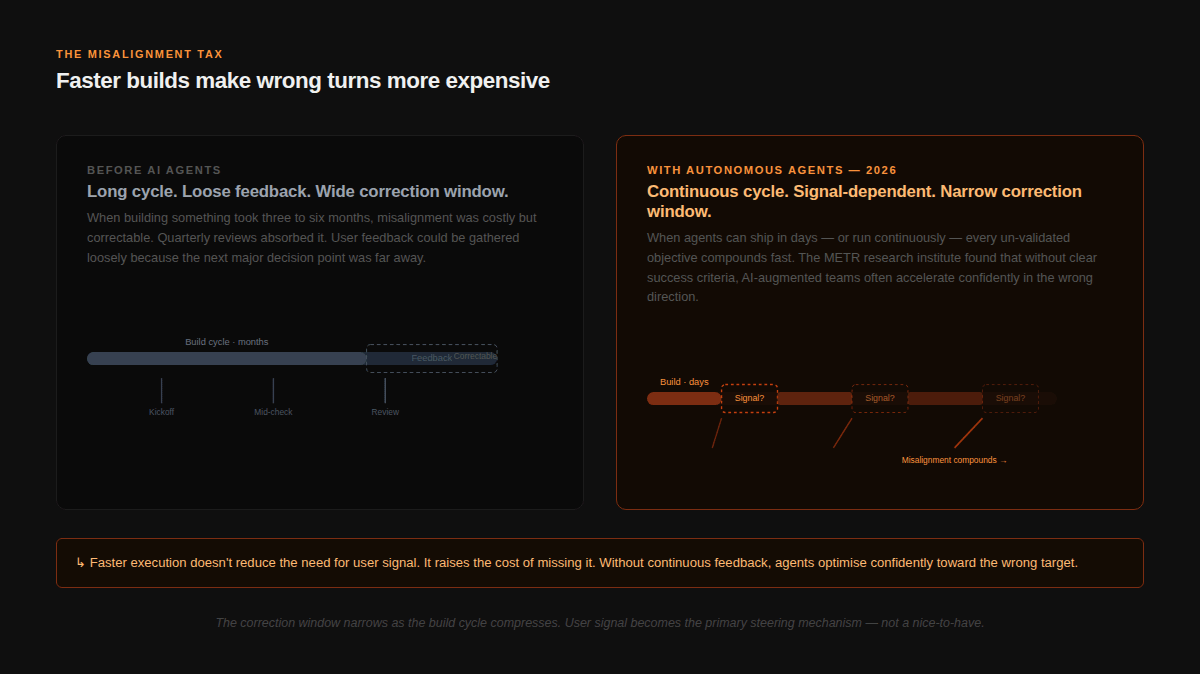
Users have never been passive recipients of what builders produce. They are the validation layer. Their adoption — or rejection, or confusion, or workaround — is the only signal that tells you whether an objective was worth pursuing. When build cycles were quarterly, misalignment was expensive but deferrable. The lag absorbed the error. You could gather user requirements loosely, build for months, and course-correct at the next review. The wide window protected you from the cost of imprecision.
That window is gone. When agents can ship in days — or run continuously — every poorly defined objective compounds in real time. Shipping in the wrong direction is no longer a quarterly problem. It is a weekly one. The correction window narrows exactly as the build velocity increases. This means the user feedback loop — once a nice-to-have between long delivery cycles — has become the primary steering mechanism of the entire product system.
The PM as the Critical Constraint
This is where the product manager’s role becomes the leverage point, not a legacy role that AI is slowly absorbing. The PM has always occupied the space between the business intent and the builder, and between the builder and the user. What has changed is the cost of doing that job poorly.
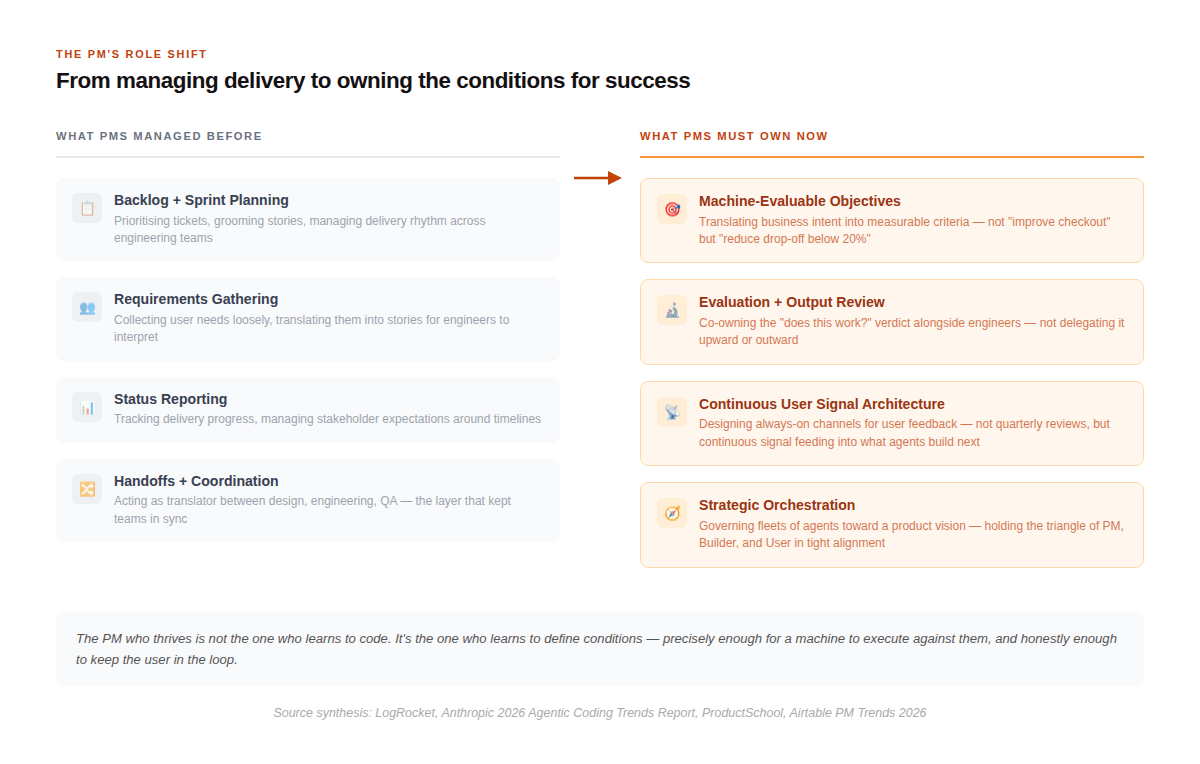
On the builder side, the PM must now do something genuinely different: translate objectives into criteria that a machine can execute against and self-evaluate. This is not the same as writing a product requirements document or a detailed user story. It requires a shift from prescriptive specification — ten-step instructions for a human developer — to what some are calling “goal vectors”: reduce checkout drop-off below 20% within seven days, within a compute budget of $500. Agents need quantified outcomes, not feature descriptions. Writing those well is a hard skill. Most PMs have not been asked to develop it yet.
On the user side, the PM must design and maintain continuous feedback channels — not quarterly reviews, not annual NPS surveys, but always-on signal architecture that feeds directly into what agents are building and how their output is being evaluated. This is not simply “talk to users more.” It is a structural investment in a loop that the rest of the product system now depends on.
The PM is now straddling both sides simultaneously — defining the machine-evaluable objective on one end, capturing the human validation signal on the other, and ensuring those two things are in genuine alignment. Two-thirds of business leaders now say they would not hire someone without AI fluency, according to the Microsoft Work Trend Index. But AI fluency in product management is not learning to code. It is learning to specify conditions of success with the precision that autonomous systems require.
What the New PM Actually Looks Like
The strongest product managers in 2026 are not the ones who have learned to write code or prompt agents directly. They are the ones who understand evaluation as a first-class product surface — who treat the feedback loop from users with the same rigour that engineers apply to system design, and who can articulate an objective to a builder (human or agent) with enough precision that it can actually be verified.
This requires being closer to two things at once: the tooling and the user. Not one or the other. PMs who lean too far into the builder side — who become focused on orchestrating agent workflows without maintaining genuine user signal — will ship increasingly polished products that solve increasingly well-optimised versions of the wrong problem. PMs who stay anchored only to user research without learning to specify evaluable objectives will find that the builder side moves without them.
The compression is not technical. It is organisational. What used to take the maximum amount of time — the build cycle — has been shortened. But the other two phases of the product development loop — understanding what needs to be built, and validating that it actually works for real people — haven’t compressed at all. They’ve become more critical, because everything now depends on them being right before the agents start moving.
The product manager who holds the triangle together — who can define objectives a machine can execute, and maintain the user loop that keeps those objectives honest — is not a legacy role being automated away. It is the rate-limiting function of every AI-accelerated product team. That is where advantage moves next. That is where it is already moving.
The author is building Auron — an AI-powered voice and conversation intelligence platform that captures and enriches organisational knowledge from meetings, calls, and conversations. Auron turns every interaction into structured signal that teams can act on.