
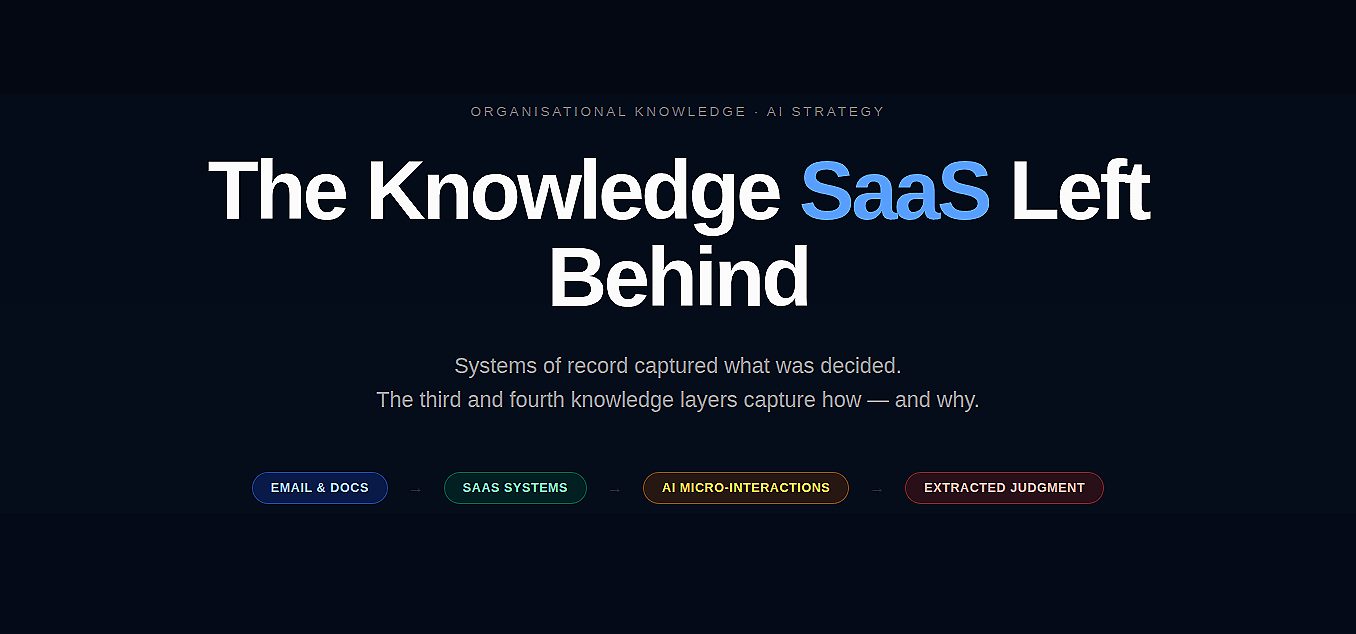
The Knowledge SaaS Left Behind
Systems of record captured what was decided. The third and fourth knowledge layers capture how — and why.

There is a thesis gaining traction among AI application builders that I have been speaking to - the moat is not “only” the model. It is the state, it is context. Whoever accumulates the richest body of organisational knowledge inside a high-value workflow — the approvals, the precedents, the edge cases, the judgment calls — builds something a competitor cannot replicate by switching to a better base model or doubling compute. The knowledge layer is the durable advantage.
The logic holds. But it sidesteps a harder question: which knowledge, exactly? Because not all organisational knowledge is equally hard to accumulate, equally hard to copy, or equally valuable once captured.
The layers that came before AI — email, documents, systems of record — each captured something real. What they consistently failed to capture is the part that matters most: not what was decided, but the reasoning, context, and judgment that led there.
That is the knowledge SaaS left behind. And it is exactly what the third and fourth layers of AI-enabled capture are now trying to reach.
What the First Two Layers Actually Captured
Every organisation already has multiple knowledge layers, built up over decades.
First is email and documents
People wrote detailed assessments, sent analyses to selected colleagues, filed notes that captured not just outcomes but interpretation. This layer could be genuinely rich — but only when the author chose to make it so. It was constrained by effort, governed by individual discretion, and siloed by design. You shared with who you chose. The knowledge existed; it rarely spread.
Second layer was the SaaS systems of record
CRM, ticketing platforms, project management tools. These did something the first layer never managed: they normalised shared organisational state. A deal stage in Salesforce is visible to the team, the manager, the forecast roll-up. Entry became part of the work, not an optional add-on. But there was a structural trade-off baked in from the start.
Systems of record were designed to capture endpoints. They recorded what was decided. They were never built to hold what happened before the decision — the negotiation, the hesitation, the exception that got granted, the reason a rep went off-playbook and turned out to be right. That knowledge stayed invisible, in the room, or in an email thread nobody forwarded.
The result is a familiar gap. Organisations have reasonable coverage of outcomes and almost no systematic capture of the reasoning behind them. The SaaS layer is wide but shallow. Its knowledge compounds slowly, because each new entry does not inform the next one — it just adds another row to the table.
The Third Layer: AI Inside the Workflow
The third knowledge layer is where AI enters the workflow itself — not as a visible tool you invoke, but as an observer embedded in the process. It watches what happens inside the system:
micro-interactions,
the approvals granted mid-flow,
the exceptions made,
the deviations from expected behaviour.
It infers from action rather than waiting for input. The individual did not choose to narrate what they were doing — the agent read it from what they did.
This layer is genuinely valuable. It closes the gap between action and record without adding friction. An approval given inside a workflow no longer disappears the moment the next task loads — it gets captured, associated with context, stored as signal. Over time, the pattern of exceptions becomes visible. The gap between policy and practice becomes legible. That is information no CRM field was ever designed to hold.
But the third layer has limits - and additional efforts are needed to mitigate it.
It captures behaviour, not meaning.
It sees what was approved, not why.
It records the deviation, not the reasoning behind it.
For certain classes of knowledge — compliance patterns, workflow bottlenecks, aggregate signal — this is enough. For the deeper judgment that actually constitutes organisational expertise, it is not.
The Fourth Layer: Elicited by Conversation
The fourth layer is structurally different, and it is where the real moat potential lives.
Here the agent does not observe — it convenes. Triggered by an event — a call just ended, a proposal has gone out, a CRM record is about to be updated — it opens a direct conversation with the human. The person is not a subject of capture; they are a participant in a dialogue. The agent asks. The person reflects.
What gets stored is the product of that exchange: interpretation, context, the reasoning behind a decision that would never have made it into a form field, captured at the moment it is freshest, before the next call or the next meeting pushes it out.
This is what distinguishes the fourth layer from everything that came before.
Email, Documents required deliberate effort and a decision to share.
SaaS required entering an endpoint into a form.
The third layer captured behaviour without meaning.
The fourth layer captures meaning — through a conversation the person is actively willing to have, at a moment when the knowledge is still alive in their head
But…
The fourth layer only compounds if the human chooses to engage honestly. Push the conversation into a workflow people resent, or make it feel like reporting rather than reflection, and what you get is the most expensive compliance theater ever built — rich-looking capture that contains nothing of real value. The mechanism amplifies intent in both directions.
Why This Layer Is Hard to Copy
The accumulated judgment in a well-functioning fourth layer is not easily replicated. A competitor can licence the same base model. They can build a similar conversation interface. What they cannot do is start with two years of an organisation’s edge cases, exceptions, and reasoning — the specific, situated knowledge that accretes when the same team uses the same layer through the same kinds of situations, repeatedly, over time.
This is what makes it a genuine moat rather than a feature. The knowledge is path-dependent. Its value comes not just from what is in it, but from how long it has been building and how specifically it reflects this organisation’s decisions in this domain. It gets harder to displace with every cycle of use.
Many builders are taking another path: piggybacking on existing SaaS data instead of building a fresh capture layer. Pull the CRM records. Ingest the transcripts. Parse the tickets. This has real advantages — no new human behaviour required, and it inherits the legitimacy battle that SaaS vendors already won. But it has a structural ceiling. It gives you coverage of the first two layers. It does not give you the third, and it cannot give you the fourth. You accumulate a very wide, very shallow knowledge base — one that tells you what was decided across thousands of records, but almost nothing about why.
Building the Layer That Actually Compounds
The builders who get this right will not solve it primarily through better extraction technology. They will solve it through the design of the contribution experience — specifically, through making the fourth layer feel valuable to the individual contributor, not just to the organisation above them.
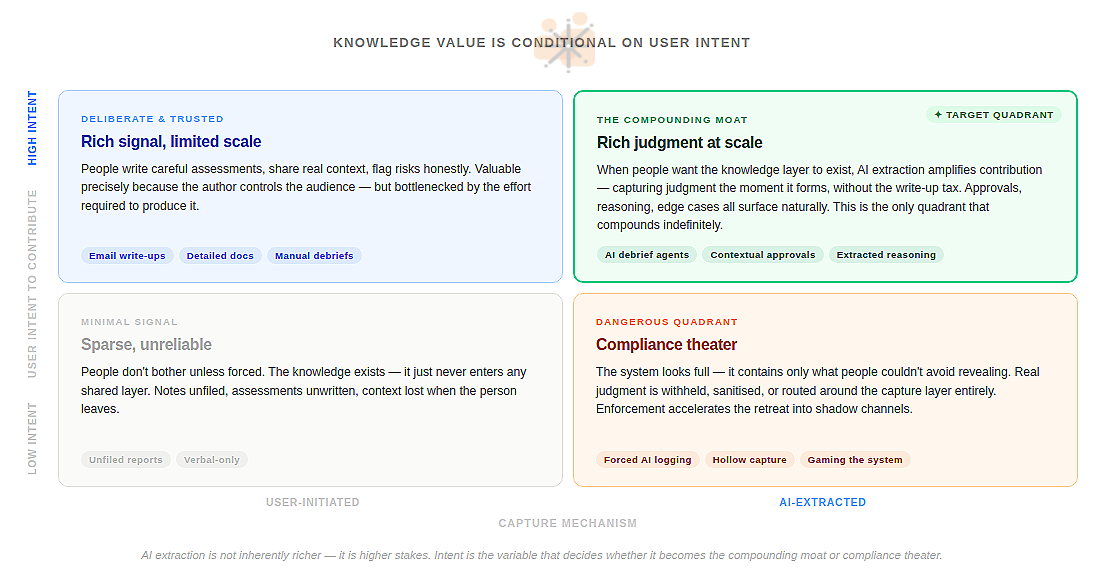
That means starting with champions: the people who have the most to gain from the knowledge base existing, who contribute early and get something demonstrably useful back. Not a mandate, not a metric — an experience of drawing on a richer layer than they had before, and wanting others to help maintain it. The initial pool does not need to be large. It needs to be convincing enough that joining feels like gaining access rather than submitting to a new reporting requirement.
It also means being deliberate about what the fourth layer asks of people. The conversation triggered after a difficult customer call has to feel like a debrief, not an audit. The agent that elicits reasoning before a CRM entry has to feel like a thinking partner, not a form with a voice. The moment that framing slips — the moment the person starts treating the conversation as something to get through rather than something that helps them — the richest knowledge stops entering the layer.
The knowledge SaaS left behind is not gone. It has been sitting in people’s heads, in unforwarded email threads, in verbal debriefs that stayed in the room. The fourth layer is a mechanism with a realistic chance of reaching it and hopefully storing it, using it systematically. Whether it does depends less on the technology than on whether people trust the layer enough to put their real judgment into it.
The author is building Auron — an AI-powered voice and conversation intelligence platform that captures and enriches organisational knowledge from meetings, calls, and conversations. Auron turns every interaction into structured signal that teams can act on.