
Evolving Landscape for Product Managers
The org chart is being redrawn. For product managers, this is a fork in the road — not a threat to manage.

Foundation Capital just published research from 25 companies about how AI is reshaping org structures. The findings are blunt: engineering teams shrinking from 120 to 25, nine functions collapsing into three, and three traditional roles — product, engineering, design — merging into two.
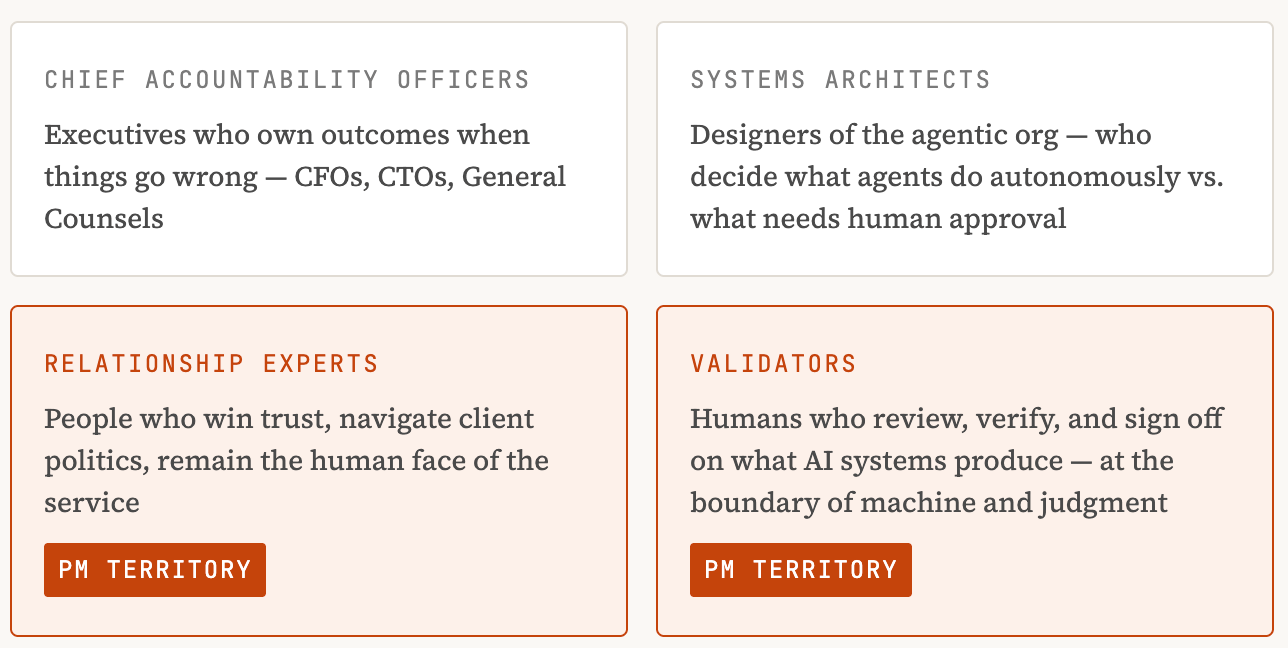
They identify four human roles that survive this reorg. Read the list and notice where the PM lands — or doesn’t.
The PM role maps — imperfectly — onto the last two. That’s a signal about where the role needs to go.
Stuck in the Middle
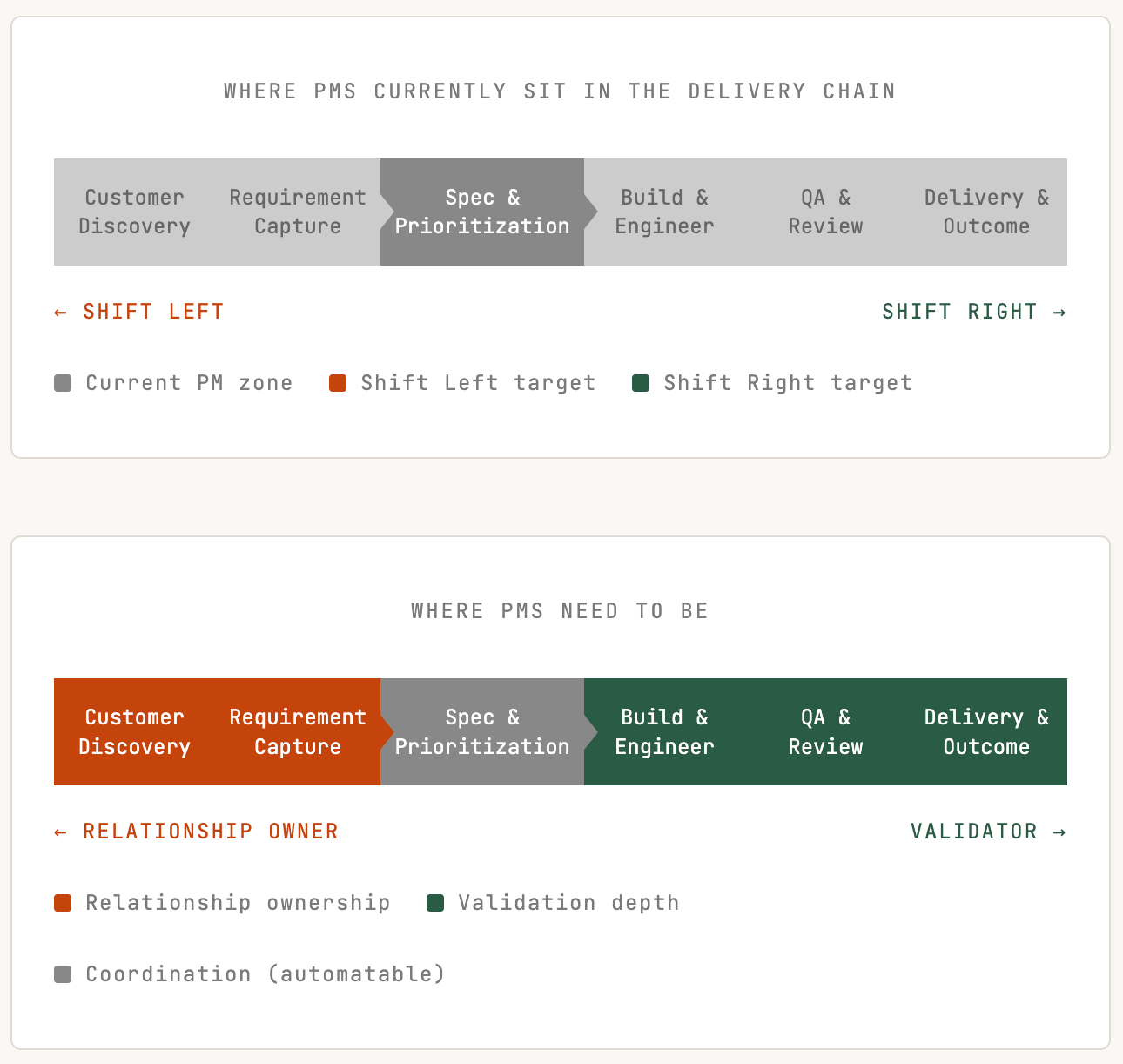
Most PMs today sit in a comfortable middle band: requirements handed to them from sales or CSMs, translated into specs, handed off to engineering. The relationship lives upstream with CS. The validation lives downstream with QA. The PM occupies a coordination layer that is, bluntly, the most automatable part of the chain.
The reorg makes the middle untenable. AI handles spec translation. Coding agents handle implementation. What remains — and becomes more valuable — are the two endpoints: the human who owns the relationship, and the human who can meaningfully validate the output.
“The PM who truly owns the relationship isn’t just capturing requirements. They’re accountable from problem discovery through delivery — not handing off to CSM once the spec is written.”
Shifting Left: The Relationship PM
A PM who shifts left owns the customer relationship at the level of understanding what the customer is actually trying to accomplish — not just what they’ve asked for. Present in discovery before requirements crystallize. Accountable to what the customer is trying to achieve for their business, not just what was written in the spec.
From the Foundation Capital research: “25–30% of product meetings now open with working prototypes instead of slide decks. The expectation has shifted from pitching ideas to demonstrating them.” A PM who shows up to a customer conversation with a working prototype — not a PRD — has fundamentally different leverage in that relationship.
This shift also changes what “requirement capture” means. When the PM owns the relationship upstream, requirements aren’t a handoff document — they’re a living contract the PM is accountable to throughout the build cycle. The customer’s context stays in the room, not in a Confluence doc that nobody reads.
Shifting Right: The Validator PM
The Foundation Capital article calls validators “arguably the most important new role of this era” — humans operating “at the boundary between what the system can do and what still requires human judgment.”
The current PM version of validation is mostly requirement adherence: did we ship what was specced? That’s the floor, not the ceiling.
The more interesting question is: does what we built actually solve the problem? That requires a PM who understands how the product behaves, not just what it was designed to do. Close enough to the implementation to evaluate outputs against intent.
One mandate from the research: every PM and non-engineer at a 1,000-person company must ship code using AI tools. The point isn’t that PMs become engineers. It’s that the distance between having an idea and seeing it work has collapsed to near zero. A PM who can’t close that gap is dependent on others to interpret whether what got built is what was needed.
The one-generation problem. Today’s validators are experts because they did the IC work themselves. If agents handle all the junior analyst work and entry-level deliverables, how does the next generation build that expertise?
For PMs, this is live right now. The PM who offloads all requirement analysis and build oversight to agents loses the fluency that makes their validation meaningful. The loop only works if the PM stays in the loop.
Validation that starts from deep product understanding creates a different customer conversation. When a PM can tell a customer not just “we built what you asked for” but “here’s how it behaves under edge conditions, and here’s where we made judgment calls and why” — that’s the conversation that builds trust. Which brings us back to shift left.
The Convergence Point
Foundation Capital treats Relationship Experts and Validators as distinct categories. For most roles, that’s right. For PMs, it misses the opportunity.
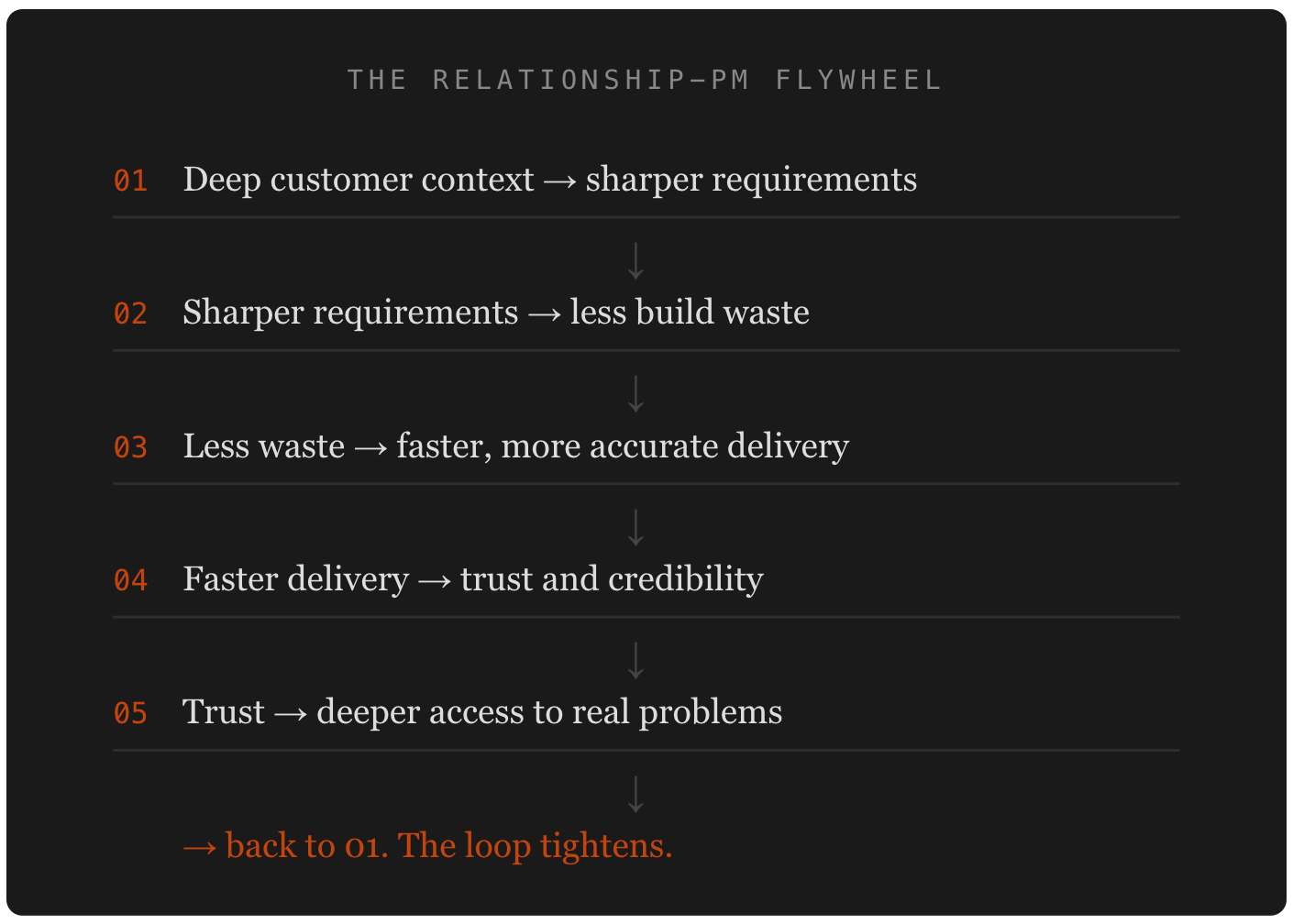
A PM who validates deeply builds the credibility to own the relationship. When you can speak to how the product actually works — not just what it was designed to do — customers trust you at a different level.
A PM who owns the relationship has the context to validate meaningfully. Without direct access to what the customer is actually trying to accomplish, validation becomes requirement checking. With that context, it becomes outcome verification.
Separating them creates two weaker roles. Combining them creates something that didn’t exist before: a PM who owns the full loop from customer problem to validated delivery.
The org is reorganizing around exactly this capability. Nine functions collapsing into three means generalists who can hold more of the chain are worth more than specialists who hand off cleanly. The PM who shifts left and right is the generalist the new org structure was built for.
“The PM who survives isn’t the one who gets better at writing PRDs. It’s the one who becomes the person the customer trusts, the person who can evaluate what the AI built, and the person who can translate between what the customer wants and what the system can actually produce.”
The question for every PM right now isn’t how to protect the role as it currently exists. It’s whether to sit at a coordination node that’s about to disappear — or to move left and right until you own the whole loop.
Referenced: Foundation Capital, “The Great Reorg: A Human’s Guide” (March 25, 2026). Research drawn from 25 companies, 50-person startups to 1,000+ person enterprises.