
Everything Is Recorded. The Intelligence Starts When the AI Talks Back
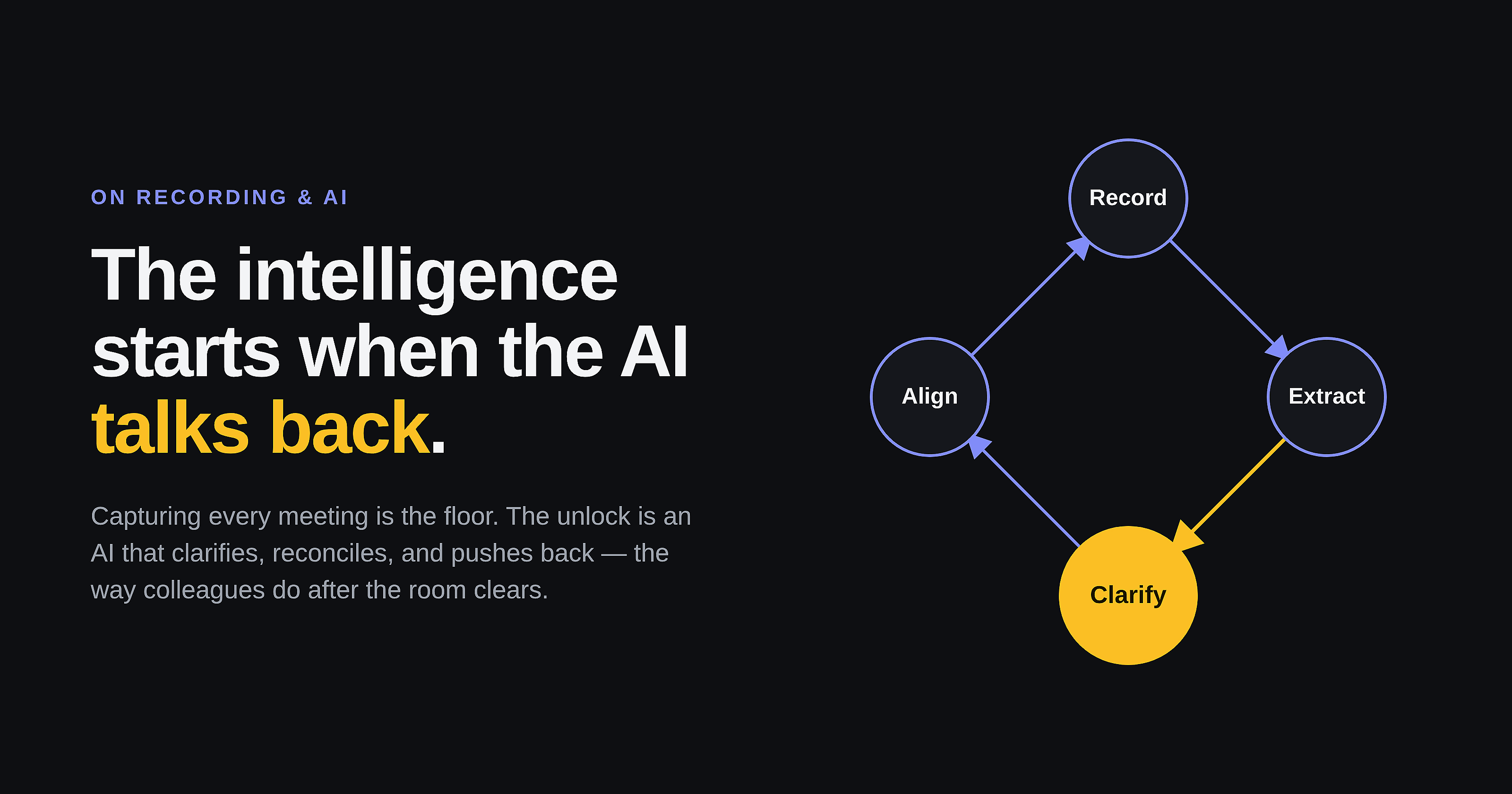
Capturing every meeting is table stakes. The real unlock is an AI that clarifies, reconciles, and pushes back — the way colleagues do after the room clears.

There’s a quiet consensus forming among people building AI into companies: meetings are now recorded by default, and that’s not going back.

The argument is sound. You onboard an AI the way you onboard a person — not by handing it the wiki, but by letting it sit in the room and absorb how the company actually thinks. The model that has ingested two years of your internal conversations is simply a better colleague than the one that only read your docs. Verbal cultures, long penalized because their best context evaporated the moment a meeting ended, finally get to compound.
I agree with all of it. But I think the framing stops one step short of where the value actually is.
Recording and extraction are passive. The implicit model is: humans talk, the AI listens, and afterward it quietly turns speech into structured data — action items, decisions, risk flags, a searchable record. That’s useful. It’s also exactly the part that’s about to become a commodity. Transcription is solved. Summarization is solved. Every meeting tool on the market can hand you bullet points by the time you close your laptop.
Here’s what those tools don’t do, and what humans do instinctively: they don’t follow up.
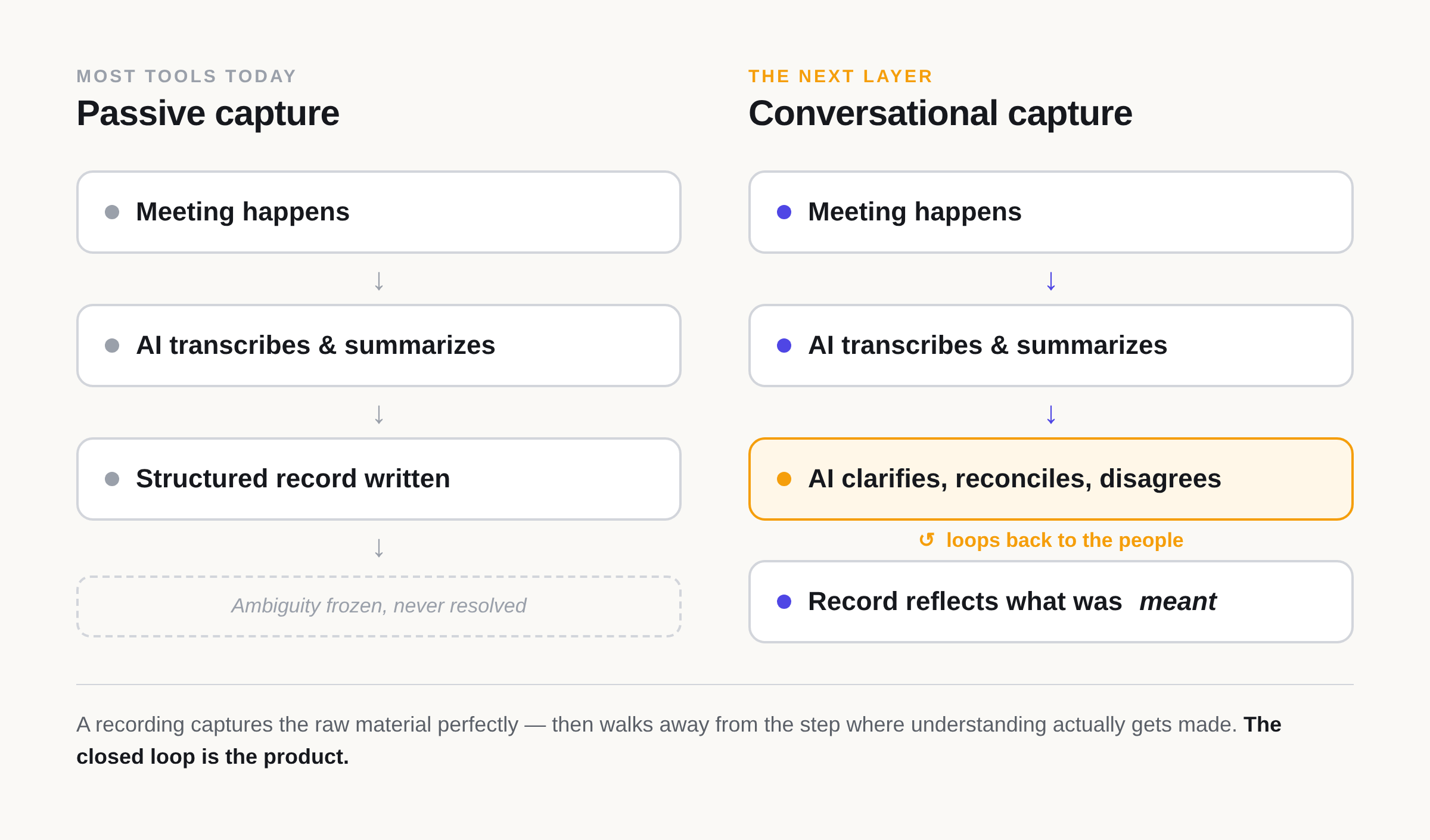
Think about what actually happens after a real meeting ends. People don’t file the minutes and move on. They catch a colleague in the hallway: “Wait, when you said we’d revisit pricing, did you mean this quarter or next?” They send the Slack message: “I don’t think we actually landed on who owns the migration.” They disagree, in private, with something the room nodded along to. They reconcile two people’s competing recollections of what was decided. The meeting is the raw material. The understanding gets manufactured afterward, through a dozen small clarifying exchanges.
A recording captures the raw material perfectly and then walks away from the manufacturing step. It freezes the ambiguity instead of resolving it. If two stakeholders left the room with different ideas of what “we’ll prioritize it” meant, the transcript preserves both — faithfully, uselessly. The AI dutifully logs “team agreed to prioritize the integration” as a clean fact, when the truth is that nobody agreed on what prioritize meant, and a human in the loop would have known to ask.
So the next layer isn’t a better listener. It’s an interlocutor.
Imagine the AI doesn’t just summarize the call — it comes back to you an hour later with three questions. “You and Priya seemed to disagree about the launch date; the transcript has you saying end of Q3 and her saying before the conference. Which is the commitment?” “The customer mentioned a budget constraint twice but you didn’t flag it — should I treat that as a real blocker?” “You said let’s take this offline about the security review. Did that conversation happen, and should I capture the outcome?”
That single move — from extraction to clarification — changes what the system is. Now it’s not building a record of what was said; it’s building a model of what was meant. It resolves the ambiguity at the source, while the context is still warm and the people are still reachable, instead of letting it harden into a confidently-wrong database entry that someone trips over three weeks later.
The candor problem gets better, not worse
This is also where the objection critics rightly raise gets answered. The fear with total recording is that people start performing for the transcript, and the messy, half-formed thinking that produces good decisions migrates to the hallway and the DM. A passive recorder makes that worse: it’s a one-way mirror, always capturing, never engaging, so the smart move is to say less.
An AI that actually talks back inverts the dynamic. If the system asks you a clarifying question, you get to add nuance, correct the record, say “that’s not quite what I meant.” It becomes a participant you can negotiate with rather than a microphone you have to manage. The loop gives people their agency back.
There’s a harder version of this too, and it’s the one I’m most interested in: an AI that’s willing to disagree. Not just “I noticed you two said different things,” but “the decision you logged contradicts the one from last month’s review — are you sure?” Humans do this constantly after meetings. They pull you aside and say the thing they didn’t want to say in the room. An assistant that only ever reflects your conversations back to you, smoothed and structured, is missing the most valuable thing a good colleague provides: friction at the right moment.
What this means if you’re building
For anyone building in this space, it reframes the roadmap. The race right now is toward better capture — more integrations, cleaner transcripts, tighter summaries. Necessary, but it’s a race to the bottom of the value stack. The defensible layer sits on top: the system that knows which ambiguities are worth surfacing, who to ask, and when. That takes judgment, not just recall — understanding that “we’ll circle back” between two executives carries different weight than the same phrase in a standup, and that a contradicted commitment is worth a question while a restated one isn’t. Get that judgment right and the clarifying loop stops feeling like more notifications and starts feeling like the one teammate who keeps everyone honest.
None of this changes the core bet. Everything is going to be recorded, the default will flip, verbal culture will scale. That’s the foundation, and it’s correct. But capture is the floor, not the ceiling. The companies that win this won’t be the ones with the most complete archive of what was said. They’ll be the ones whose AI treats every recording as the opening of a conversation, not the end of one — clarifying, reconciling, occasionally pushing back, until the captured context actually reflects reality.
The recording is where intelligence used to stop. It should be where it starts.
The author is building Auron — an AI-powered voice and conversation intelligence platform that captures and enriches organizational knowledge from meetings, calls, and conversations. Auron turns every interaction into structured signal that teams can act on.