
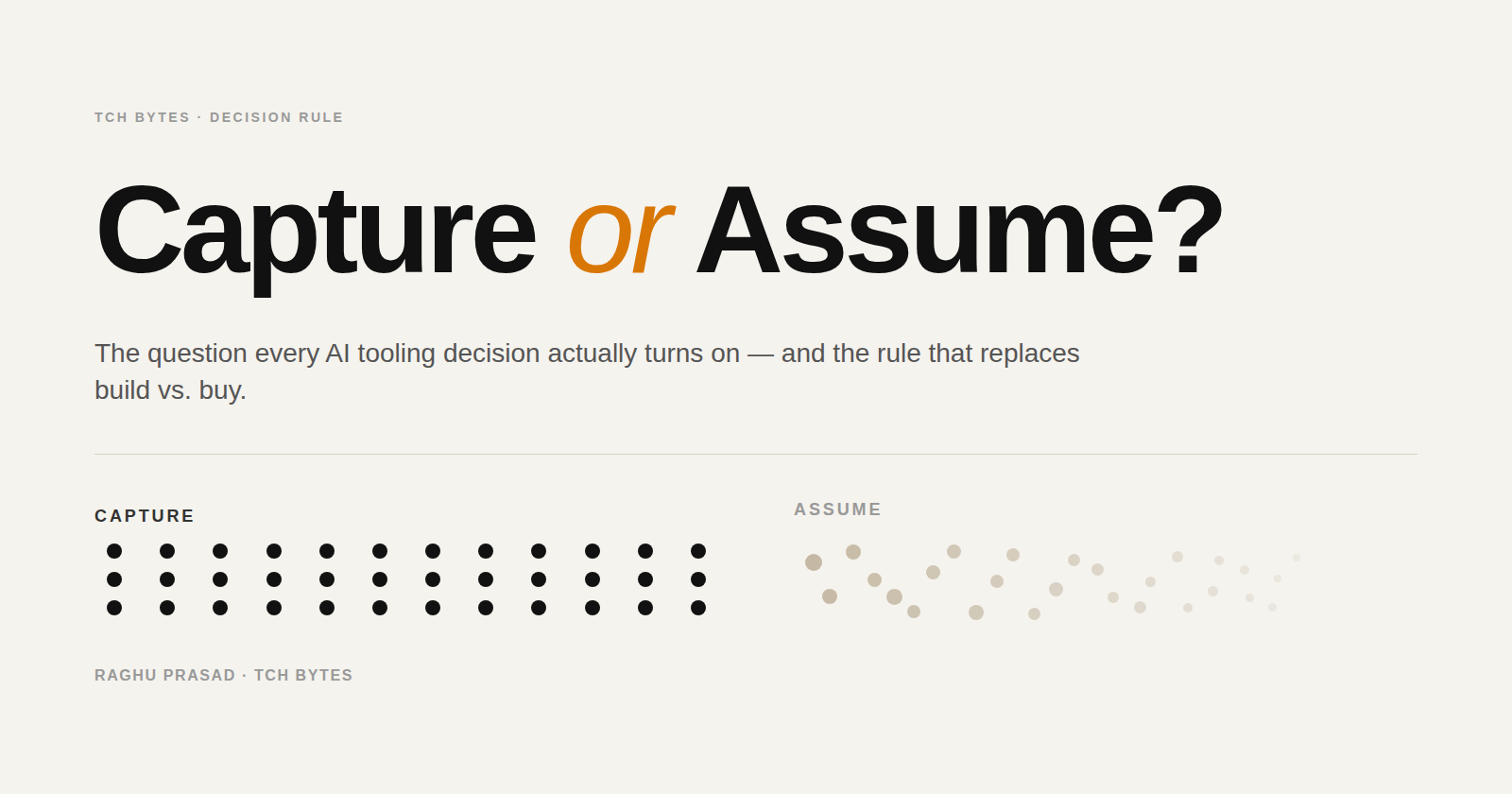
Capture or Assume?
The question every AI tooling decision actually turns on — and the rule that replaces build vs. buy.

A recent Harvard Business Review piece on the end of one-size-fits-all enterprise software asks the right question: which workflows do you actually need to own? It’s a useful framing. But it leaves the executive without a way to answer it on a Tuesday morning. So they default to the rule they already know — build vs. buy — and the answer comes out wrong.
Build vs. buy is dead. It was a rule built on SaaS economics: build meant eighteen months of engineering, buy meant a multi-year contract. Both sides have quietly collapsed.
Build is no longer slow. Coding agents — Claude Code, Codex, Cursor and others — turn what used to be multi-week scaffolding into an afternoon’s work. The unit of construction is now assembly, not engineering, and the cost of bespoke is a fraction of what it was.
Buy is no longer locked in. Headless platforms like Salesforce 360 and SAP, open standards like MCP, and vendors quietly unbundling themselves for AI access have turned what was a seven-year contractual moat into something extractable. The data and the state your CRM / ERP for example used to hold hostage are, increasingly, something you can pull out and route elsewhere.
The axis no longer maps to a decision worth having.
Here’s a simpler rule to use instead: capture or assume?
For every important thing your business runs on — why deals are won, why deals are lost, why an architecture call was made the way it was, what your top performer actually does differently from the median — ask one question. Are we capturing this as structured decision traces, or are we assuming it lives somewhere we can reconstruct later?
That’s it. That’s the rule. Most enterprise AI tooling decisions, on inspection, are capture-vs-assume decisions in disguise.
Why “assume” wins by default
Capture has a process cost. Someone has to stop and commit a thought to a schema. There’s a moment of friction. Assume is free in the moment — you skip the friction, the meeting ends, everyone moves on.
So organisations default to assume. Then, six months later, they buy AI tooling to reconstruct what nobody captured. The whole retrieval-driven AI category — copilots that scrape transcripts, agents that re-index your Slack, dashboards that distil last quarter’s meetings — is a monument to this failure. They exist to retrieve decision traces that were never written down. Reconstruction is always second-best — and the gap between captured decision traces and lossy reconstructions compounds quietly across every deal, every hire, every decision.
Most enterprise AI spend is, on inspection, a reconstruction tax for decision traces that should have been captured the first time.
The audit
Pick five things your business genuinely depends on. For each one, ask whether you’re capturing it or assuming it.
Why deals are won and lost.
Why a senior engineer made that architecture call.
What your top performer actually does differently from the median.
Why the strategy changed last quarter.
Customer objections and the real shape of their pain points.
Most leaders will quietly notice they’ve assumed all five. That’s the finding. That’s also the cost — paid forward, in tooling contracts that exist to reconstruct what should never have needed reconstruction.
The rule of thumb
Capture if it’ll matter in three years. Capture if it’s where you actually compete. Capture if it’s a decision trace that lives only in someone’s head. Assume the rest. Don’t capture what the model already knows or what your existing systems already hold — that’s reconstruction tax in advance.
Capture is irreversible, proprietary, and trace-worthy. Assume is everything else.
The takeaway
Build vs. buy asked: how do we get capability? Capability is now cheap. The new question is: how do we capture decision traces? Because they’re the only things that compound and ensure you can get more value from AI as your usage progresses.
Run the capture-or-assume audit on your business before you sign another AI tooling contract. Most leaders will find that half their AI spend exists to fix problems they created by assuming.
The author is building Auron — an AI-powered voice and conversation intelligence platform that captures and enriches organizational knowledge from meetings, calls, and conversations. Auron turns every interaction into structured signal that teams can act on.